
Heidegger, Habermas and the Mobile Phone (Postmodern Encounters)
George MyersonPublished2001
Pages80
Formatpaperback
PublisherIcon,Totem Books
Synopsis
Move over e-commerce, mantra of the late 20th century... welcome in-commerce, catchword of the new millennium! Everyone remembers 'It's good to talk, the cosy slogan of the telephone at the end of the last century. But now we are witnessing a global campaign to promote the mobile: as credit card, Internet link, e-mail port, and, if you still have time, voice-mail junction. By 2003, we are told, there will be 900 million Internet-connected mobiles. This Postmodern Encounter gives the gist of the massive campaign to mobilise the globe, and asks the urgent question: what is happening to the idea of communication? Key thinkers of the 20th century offer an essential alternative to these new doctrines of m-communication: Martin Heidegger, who saw humanity as "the entity which talks", and Jurgen Habermas, current-day advocates of authentic communication. This is a close encounter between alien visions of communication - between the conflicting utopianisms of 20th-century philosophers and 21st-century "mobilised communication."
Recommendations
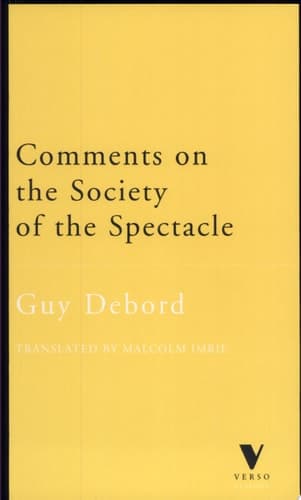
Comments on the Society of the Spectacle
by Guy Debord
Debord's 1967 critique of how media and commodities shape human consciousness reads like the philosophical ancestor to Myerson's concerns about mobile communication. Where Myerson asks what happens to authentic communication in the age of m-commerce, Debord spent decades anatomizing how spectacle colonizes even our most intimate moments—and his arguments feel urgently contemporary when you apply them to smartphones.
View book
The Gutenberg Elegies The Fate of Reading in an Electronic Age
by Sven Birkerts
Birkerts writes with the same philosophical urgency as Myerson, but focuses on how digital technology fragments our capacity for deep reading and contemplation. He's less interested in grand theory than in the lived experience of consciousness changing—what it *feels* like when the page gives way to the screen—making this a more intimate companion to Myerson's Habermasian concerns about authentic exchange.
View book
A Commentary on Jean-Paul Sartre's Being and Nothingness
by Joseph S. Catalano
This is the surprise pick: Sartre's massive phenomenology of human consciousness gives you the existential foundations that both Heidegger and Habermas are working from, but Sartre's obsession with *authenticity* and *bad faith* (how we deceive ourselves about our freedom) becomes a lens for understanding why Myerson worries about m-communication in the first place. You'll see how the pressure to be always-connected, always-available is fundamentally a problem of self-deception.
View book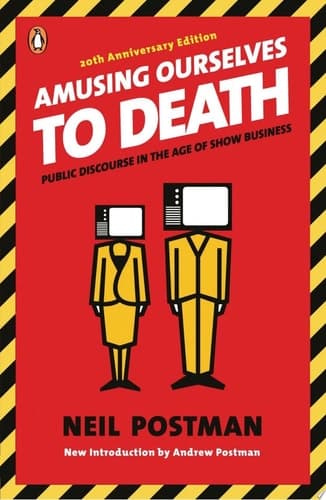
Amusing Ourselves to Death Public Discourse in the Age of Show Business
by Neil Postman
Postman's 1985 book predates Myerson's mobile phone anxieties but diagnoses the same disease: how entertainment logic colonizes all communication, turning discourse into spectacle. What makes this pairing special is that Postman writes with a clarity and accessibility that Myerson sometimes lacks, and his historical perspective (comparing television to print culture) gives you a longer view of how each technology reshapes what we think communication *is*.
View book
The Practice of Everyday Life
by Michel de Certeau
De Certeau offers something Myerson doesn't quite capture: how ordinary people actually *use* technologies in ways that subvert corporate intentions. While Myerson worries about what mobile companies are doing *to* communication, de Certeau shows how users tactically improvise meanings and resistances within systems designed to control them. It's a more optimistic counterweight that complicates the doom-and-gloom narrative without dismissing the real problems.
View bookAbout George Myerson
G
George Myerson
Born 1957
Biography coming soon.
View author page