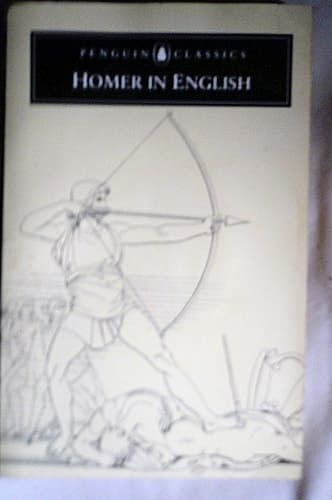
Homer in English (Poets in Translation, Penguin)
HomerPublished1996
Pages400
Formatpaperback
PublisherPenguin Classics
Synopsis
'The Iliad and Odyssey,' writes Professor George Steiner, 'are perennially active in the pulse of the English languages, in the texts and contexts of Anglo-Saxon self-definition; these translations and variations on Homeric themes offer nothing less than 'a concise chronicle of English'.
From Lydgate's Troy Book, Chaucer's Troylus and Criseyde and Shakespeare's Troilus and Cressida to Pound's Cantos, Joyce's Ulysses and Derek Walcott's Omeros, Homer has been the most translated author and presence in our literature and languages (such as American and Afro-Caribbean). Homer has elicited a fantastic wealth and quality of response, from Hobbes to Gladstone, from T. E. Lawrence to Robert Graves. Homeric translations by Chapman, Dryden, Pope, Shelley and Christopher Logue are masterpieces in their own right. This superb selection assembles highlights and representative moments from six and a half centuries.
Recommendations
Generating recommendations…
Our AI is preparing recommendations for Homer in English (Poets in Translation, Penguin). This usually takes under a minute.
About Homer
Ο Όμηρος είναι ο δημιουργός των ποιητικών έργων της Ιλιάδας και της Οδύσσειας, από τα πρώτα κείμενα της Ιστορικής περιόδου της αρχαίας Ελλάδας, γνωστών ως «Ομηρικά Έπη». Η Ιλιάδα αποτελείται από 15.693 στίχους και αναφέρεται στις τελευταίες πενήντα μία, αποφασιστικής σημασίας ημέρες του πολέμου της Τροίας, ο οποίος συνολικά διήρκεσε, σύμφωνα με τον μύθο, 10 χρόνια. Η Οδύσσεια αποτελείται από 12.110 στίχους και περιγράφει τον δεκαετή αγώνα του Οδυσσέα για τον νόστο (επιστροφή στην πατρίδα του Ιθάκη μετά την κατάληψη της Τροίας). Η γλώσσα των κειμένων είναι η ομηρική ελληνική, μια λογοτεχνική γλώσσα με ανάμειξη χαρακτηριστικών από την ιωνική και την αιολική διάλεκτο με κύρια επιρροή την ανατολική ιωνική διάλεκτο. Πολλοί ερευνητές πιστεύουν ότι αρχικά τα ποιήματα μεταδόθηκαν προφορικά. ---------- Homer (Ancient Greek: Ὅμηρος) was an ancient Greek author and epic poet. He is the reputed author of the Iliad and the Odyssey, the two epic poems that are the foundational works of ancient Greek literature. He is regarded as one of the greatest and most influential authors of all time. The Homeric epics were the greatest influence on ancient Greek culture and education. From antiquity until the present day, the influence of Homeric epic on Western civilization has been great, inspiring many of its most famous works of literature, music, art and film. The poems are in Homeric Greek, also known as Epic Greek, a literary language which shows a mixture of features of the Ionic and Aeolic dialects from different centuries; the predominant influence is Eastern Ionic. Most researchers believe that the poems were originally transmitted orally. The ancient Greeks generally believed that Homer was an historical individual, but modern scholars are skeptical: no reliable biographical information has been handed down from classical antiquity, and the poems themselves manifestly represent the culmination of many centuries of oral story-telling and a well-developed "formulaic" system of poetic composition. According to Martin West, "Homer" is "not the name of a historical poet, but a fictitious or constructed name."
View author page