Synopsis
The Odyssey is one of the earliest works of European literature, second only to the Iliad. These two great epic poems, the astonishing first fruits of Greek civilization, have together determined much of the course of Western literary culture and imagination.
The poem tells of the long and painful return of Odysseus from the Trojan War to his homeland of Ithaka, his wife Penelope and his son Telemachos. Even after he finally returns, there are enemies to be fought in his house. The action of the poem covers a huge canvas, ranging widely over time and place, exploring the known and unknown worlds, involving magic and monsters, gods and ghosts, dangers defied: throughout there runs a strong and eloquent insistence on the humanity of men and the ultimate triumph of good over evil.
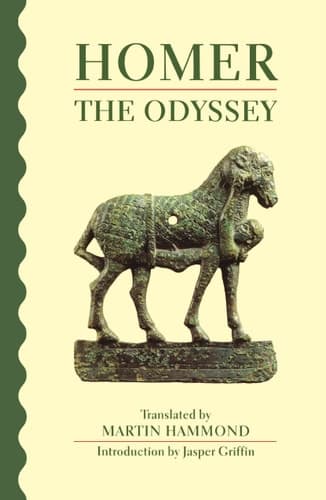
In this vibrant new translation, in a very readable prose format, Martin Hammond complements his acclaimed translation of the Iliad to capture as closely as possible both the simplicity and the intensity of Homer's epic. With an introduction by Professor Jasper Griffin and a comprehensive index, it sets a new and lasting standard in the interpretation of a masterpiece of Greek literature for both the student and the general reader.
Recommendations
Generating recommendations…
Our AI is preparing recommendations for Homer: The Odyssey. This usually takes under a minute.
About Homer
Ο Όμηρος είναι ο δημιουργός των ποιητικών έργων της Ιλιάδας και της Οδύσσειας, από τα πρώτα κείμενα της Ιστορικής περιόδου της αρχαίας Ελλάδας, γνωστών ως «Ομηρικά Έπη». Η Ιλιάδα αποτελείται από 15.693 στίχους και αναφέρεται στις τελευταίες πενήντα μία, αποφασιστικής σημασίας ημέρες του πολέμου της Τροίας, ο οποίος συνολικά διήρκεσε, σύμφωνα με τον μύθο, 10 χρόνια. Η Οδύσσεια αποτελείται από 12.110 στίχους και περιγράφει τον δεκαετή αγώνα του Οδυσσέα για τον νόστο (επιστροφή στην πατρίδα του Ιθάκη μετά την κατάληψη της Τροίας). Η γλώσσα των κειμένων είναι η ομηρική ελληνική, μια λογοτεχνική γλώσσα με ανάμειξη χαρακτηριστικών από την ιωνική και την αιολική διάλεκτο με κύρια επιρροή την ανατολική ιωνική διάλεκτο. Πολλοί ερευνητές πιστεύουν ότι αρχικά τα ποιήματα μεταδόθηκαν προφορικά. ---------- Homer (Ancient Greek: Ὅμηρος) was an ancient Greek author and epic poet. He is the reputed author of the Iliad and the Odyssey, the two epic poems that are the foundational works of ancient Greek literature. He is regarded as one of the greatest and most influential authors of all time. The Homeric epics were the greatest influence on ancient Greek culture and education. From antiquity until the present day, the influence of Homeric epic on Western civilization has been great, inspiring many of its most famous works of literature, music, art and film. The poems are in Homeric Greek, also known as Epic Greek, a literary language which shows a mixture of features of the Ionic and Aeolic dialects from different centuries; the predominant influence is Eastern Ionic. Most researchers believe that the poems were originally transmitted orally. The ancient Greeks generally believed that Homer was an historical individual, but modern scholars are skeptical: no reliable biographical information has been handed down from classical antiquity, and the poems themselves manifestly represent the culmination of many centuries of oral story-telling and a well-developed "formulaic" system of poetic composition. According to Martin West, "Homer" is "not the name of a historical poet, but a fictitious or constructed name."
View author page