Synopsis
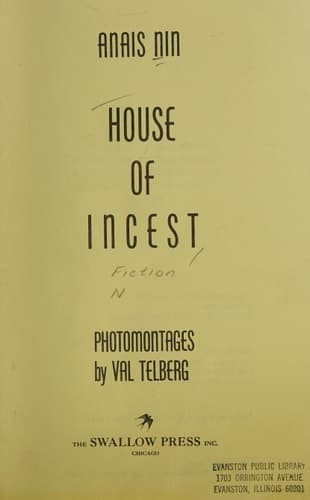
With an introduction by Allison Pease, this new edition of House of Incest is a lyrical journey into the subconscious mind of one of the most celebrated feminist writers of the twentieth-century.
Originally published in 1936, House of Incest is Anaïs Nin’s first work of fiction. Based on Nin’s dreams, the novel is a surrealistic look within the narrator’s subconscious as she attempts to distance herself from a series of all-consuming and often taboo desires she cannot bear to let go. The incest Nin depicts is a metaphor—a selfish love wherein a woman can appreciate only qualities in a lover that are similar to her own. Through a descriptive exploration of romances and attractions between women, between a sister and her beloved brother, and with a Christ-like man, Nin’s narrator discovers what she thinks is truth: that a woman’s most perfect love is of herself. At first, this self-love seems ideal because it is attainable without fear and risk of heartbreak. But in time, the narrator’s chosen isolation and self-possessed anguish give way to a visceral nightmare from which she is unable to wake.
Recommendations
Generating recommendations…
Our AI is preparing recommendations for House Of Incest. This usually takes under a minute.
About Anaïs Nin

Anaïs Nin is known internationally for her diary, eleven volumes of which have been published. The 35,000 handwritten pages of her journals are currently located in the UCLA library. She was born in Paris to Cuban parents, and spent her early years in Cuba and Spain. Her young adulthood was spent in Paris and she and her husband, Hugo Guiler, moved to the United States in 1939 to avoid World War II. After meeting Rupert Pole in 1947 she engaged in a "bicoastal trapeze" living with him in Los Angeles as a married couple and maintaining her marriage with Guiler in New York. She died of cervical cancer in 1977.
View author page