Synopsis
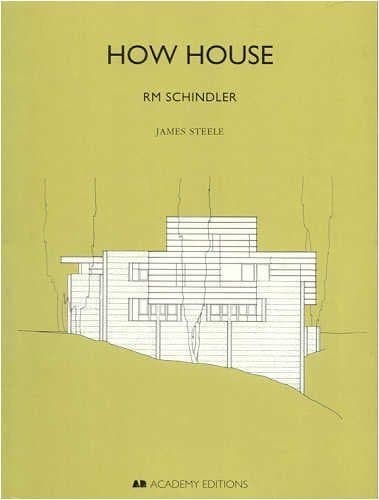
This monograph examines How House - arguably, one of Rudolf Schindler's greatest achievements. Built in 1924 and 1925 for an eccentric member of one of the wealthiest families in America, it is based on the idea of refraction and transparency, in which glass has been used to enhance scale.
Recommendations
Theory and Design in the First Machine Age
by Reyner Banham
Since you've clearly developed an appreciation for Schindler's California modernism, Whiteley's examination of the Santa Monica School contextualizes How House within a broader movement of architects who were rethinking domestic space through radical transparency and site-specificity. You'll find the same intellectual rigor Steele brings to his monograph, but expanded to show how Schindler's ideas influenced and were influenced by his contemporaries.
View book
The Glass House The Life of Theodore Roethke
by Allan Seager
Lamster's biography reads like a architectural thriller—Johnson's own Glass House was built just a decade after How House, yet their approaches to transparency and materiality diverged dramatically. Where Steele focuses on a single building's philosophical underpinnings, Lamster uses Johnson's life to explore how glass became a contested symbol in modernism, making this a natural intellectual companion that challenges some of Schindler's assumptions.
View book
The Poetics of Space
by Gaston Bachelard
Here's your surprise pick: this 1958 phenomenological meditation on how we inhabit enclosed spaces will completely reframe how you think about How House's use of glass and refraction. Bachelard writes almost like a poet about corners, thresholds, and transparency—he'll help you understand not just what Schindler built, but why the psychological experience of moving through that space matters as much as its geometric precision.
View book
Beyond Mechanism: The Universe in Recent Physics and Catholic Thought
by David L. Schindler
Gebhard's monograph takes a different angle than Steele's How House study—he's interested in Schindler's working method and how his ideas about construction shaped form. If you found yourself wanting to understand *how* Schindler thought about building, not just what he built, this gives you the technical and conceptual framework that Steele's focused study necessarily leaves aside.
View book
Architecture of the Well-Tempered Environment
by Reyner Banham
Banham's 1969 polemic argues that modern architecture's obsession with visual purity (like Schindler's transparent glass walls) often ignores the mechanical systems that actually make buildings livable. It's a provocative counterargument to the aesthetic philosophy underlying How House—Banham would ask: but what about the heating? The cooling? It's a delightful intellectual sparring match with the very building you just finished studying.
View bookAbout James Steele
J
James Steele
Born 1943
Biography coming soon.
View author page