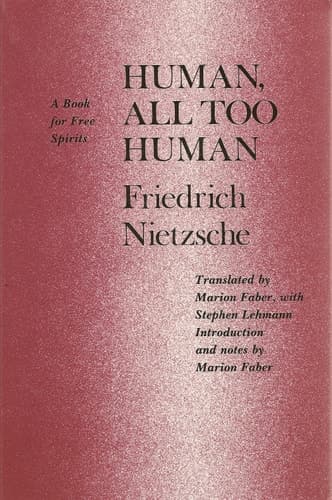
Human, All Too Human A Book for Free Spirits
Friedrich Wilhelm NietzschePublished1984
Pages275
Formatpaperback
PublisherUniversity of Nebraska Press
Synopsis
"" This English translation the first since 1909 restores "Human, All Too Human" to its proper central position in the Nietzsche canon. First published in 1878, the book marks the philosophical coming of age of Friedrich Nietzsche. In it he rejects the romanticism of his early work, influenced by Wagner and Schopenhauer, and looks to enlightened reason and science. The "Free Spirit" enters, untrammeled by all accepted conventions, a precursor of Zarathustra. The result is 638 stunning aphorisms about everything under and above the sun.
Recommendations
Generating recommendations…
Our AI is preparing recommendations for Human, All Too Human A Book for Free Spirits. This usually takes under a minute.
About Friedrich Wilhelm Nietzsche
F
Friedrich Wilhelm Nietzsche
1917–1979
Giorgio Colli (1917 – 6 January 1979) was an Italian philosopher, philologist and historian. A native of Turin, taught ancient philosophy at Pisa's university for thirty years; he edited and translated Aristotle's *Organon and Kant's Critique of Pure Reason* for Einaudi, a major publishing house in Italy. Subsequently, he produced the first complete edition of Nietzsche's work (including all the posthumous fragments chronologically ordered) together with his friend Mazzino Montinari. His work culminated in *La Sapienza greca*, an edition and translation of the "Presocratics" (a term he rejected). Interrupted by his death in January 1979, it was supposed to be in eleven volumes. **Source**: [Giorgio Colli](https://en.wikipedia.org/wiki/Giorgio_Colli) on Wikipedia.
View author page