Synopsis
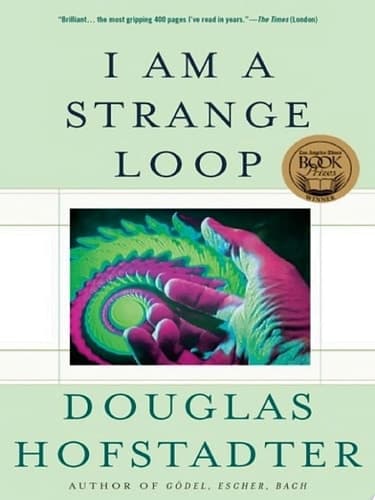
What do we mean when we say "I"? Can thought arise out of matter? Can a self, a soul, a consciousness, an "I" arise out of mere matter? If it cannot, then how can you or I be here? I Am a Strange Loop argues that the key to understanding selves and consciousness is the "strange loop"--a special kind of abstract feedback loop inhabiting our brains. Deep down, a human brain is a chaotic seething soup of particles, on a higher level it is a jungle of neurons, and on a yet higher level it is a network of abstractions that we call "symbols." The most central and complex symbol in your brain or mine is the one we both call "I." The "I" is the nexus in our brain where the levels feed back into each other and flip causality upside down, with symbols seeming to have free will and to have gained the paradoxical ability to push particles around, rather than the reverse. For each human being, this "I" seems to be the realest thing in the world. But how can such a mysterious abstraction be real--or is our "I" merely a convenient fiction? Does an "I" exert genuine power over the particles in our brain, or is it helplessly pushed around by the all-powerful laws of physics? These are the mysteries tackled in I Am a Strange Loop, Douglas R. Hofstadter's first book-length journey into philosophy since Godel, Escher, Bach. Compulsively readable and endlessly thought-provoking, this is the book Hofstadter's many readers have long been waiting for.
Recommendations
Generating recommendations…
Our AI is preparing recommendations for I Am a Strange Loop. This usually takes under a minute.
About Douglas R. Hofstadter
D
Douglas R. Hofstadter
Born 1945
Douglas Hofstadter is an American scholar of cognitive science, physics, and comparative literature whose research includes concepts such as the sense of self in relation to the external world, consciousness, analogy-making, artistic creation, literary translation, and discovery in mathematics and physics. His 1979 book *Gödel, Escher, Bach: An Eternal Golden Braid* won both the Pulitzer Prize for general nonfiction and a National Book Award for Science. His 2007 book *I Am a Strange Loop* won the *Los Angeles Times* Book Prize for Science and Technology.—*Wikipedia* 2021-03-03
View author page