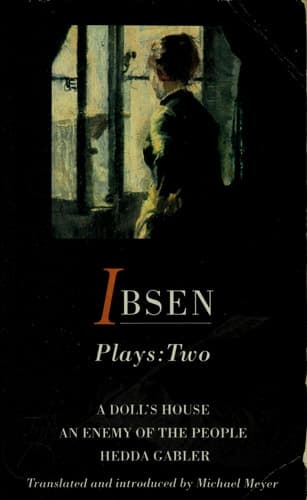
Ibsen Plays: 2 A Doll's House; An Enemy of the People; Hedda Gabler
Henrik IbsenPublished1980
Pages336
Formatpaperback
PublisherBloomsbury Academic
Synopsis
This volume contains Ibsen's two most famous and frequently read, studied and performed plays about women: A Doll's House (1879), his first international success, which 'exploded like a bomb into contemporary life', and Hedda Gabler (1890), now one of his most popular plays, but greeted at first with bewilderment and outrage ('The play is simply a bad escape of moral sewage-gas' Pictorial World). Also included is An Enemy of the People (1883), whose central character was the actor Konstantin Stanislavski's favourite role.
Michael Meyer's translations are 'crisp and cobweb-free, purged of verbal Victoriana' (Kenneth Tynan)
Recommendations
Generating recommendations…
Our AI is preparing recommendations for Ibsen Plays: 2 A Doll's House; An Enemy of the People; Hedda Gabler. This usually takes under a minute.
About Henrik Ibsen
H
Henrik Ibsen
1828–1906
Henrik Ibsen was a major 19th-century Norwegian playwright, theatre director, and poet. He is often referred to as "the god father" of modern drama and is one of the founders of Modernism in the theatre.[1] His plays were considered scandalous to many of his era, when Victorian values of family life and propriety largely held sway in Europe. Ibsen's work examined the realities that lay behind many facades, possessing a revelatory nature that was disquieting to many contemporaries. It utilized a critical eye and free inquiry into the conditions of life and issues of morality. Ibsen is often ranked as one of the truly great playwrights in the European tradition, alongside Shakespeare. <cite>— [Wikipedia](https://en.wikipedia.org/wiki/Henrik_Ibsen)</cite>
View author page