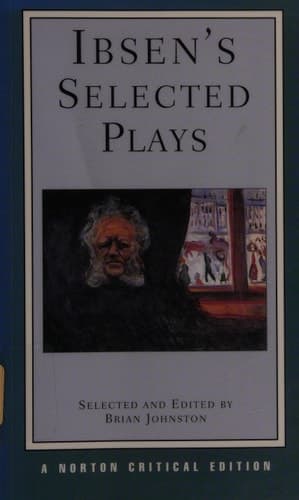
Ibsen's Selected Plays (Norton Critical Editions)
Henrik IbsenPublished2004
Pages612
Formatpaperback
PublisherW. W. Norton & Company
Synopsis
Ibsen ascended to the first ranks of European writers in the late nineteenth century and has remained there ever since.
The Norton Critical Edition includes five major plays spanning Ibsen’s long career in recent translations by Brian Johnston (Peer Gynt, The Wild Duck, and The Master Builder) and Brian Johnston and Rick Davis (A Doll House and Hedda Gabler). The translation of Peer Gynt appears for the first time in this Norton Critical Edition.
“Backgrounds” gives students an understanding of Ibsen’s creative process with selections from his correspondence and other writings. Twenty-seven documents have been collected and arranged by play, with a section of autobiographical writings at the end.
Ibsen’s plays continue to provoke diverse commentary. “Criticism” includes nineteen of the most important responses to Ibsen’s work, among them essays by Bernard Shaw, Sandra Saari, E. M. Forster, Hugh Kenner, and Joan Templeton.
A Chronology and Selected Bibliography are also included.
Recommendations
Generating recommendations…
Our AI is preparing recommendations for Ibsen's Selected Plays (Norton Critical Editions). This usually takes under a minute.
About Henrik Ibsen
H
Henrik Ibsen
1828–1906
Henrik Ibsen was a major 19th-century Norwegian playwright, theatre director, and poet. He is often referred to as "the god father" of modern drama and is one of the founders of Modernism in the theatre.[1] His plays were considered scandalous to many of his era, when Victorian values of family life and propriety largely held sway in Europe. Ibsen's work examined the realities that lay behind many facades, possessing a revelatory nature that was disquieting to many contemporaries. It utilized a critical eye and free inquiry into the conditions of life and issues of morality. Ibsen is often ranked as one of the truly great playwrights in the European tradition, alongside Shakespeare. <cite>— [Wikipedia](https://en.wikipedia.org/wiki/Henrik_Ibsen)</cite>
View author page