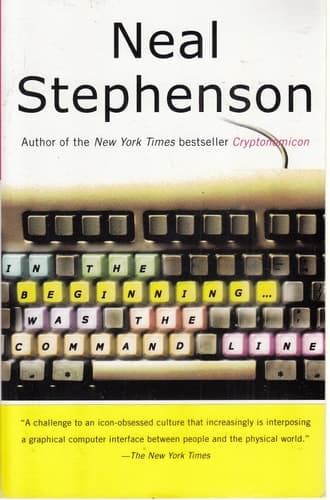
In the Beginning...was the Command Line
Neal StephensonPublished2003
Pages160
Formatpaperback
PublisherHarperCollins
Synopsis
This is "the Word" -- one man's word, certainly -- about the art (and artifice) of the state of our computer-centric existence. And considering that the "one man" is Neal Stephenson, "the hacker Hemingway" (Newsweek) -- acclaimed novelist, pragmatist, seer, nerd-friendly philosopher, and nationally bestselling author of groundbreaking literary works (Snow Crash, Cryptonomicon, etc., etc.) -- the word is well worth hearing. Mostly well-reasoned examination and partial rant, Stephenson's In the Beginning...was the Command Line is a thoughtful, irreverent, hilarious treatise on the cyber-culture past and present; on operating system tyrannies and downloaded popular revolutions; on the Internet, Disney World, Big Bangs, not to mention the meaning of life itself.
Recommendations
Generating recommendations…
Our AI is preparing recommendations for In the Beginning...was the Command Line. This usually takes under a minute.
About Neal Stephenson
N
Neal Stephenson
Born 1959
Neal Town Stephenson (born October 31, 1959) is an American writer and game designer known for his works of speculative fiction. His novels have been categorized as science fiction, historical fiction, cyberpunk, postcyberpunk, and baroque. Stephenson's work explores subjects such as mathematics, cryptography, linguistics, philosophy, currency, and the history of science. He also writes non-fiction articles about technology in publications such as *Wired*. He has also written novels with his uncle, George Jewsbury ("J. Frederick George"), under the collective pseudonym Stephen Bury. Stephenson has worked part-time as an advisor for Blue Origin, a company (funded by Jeff Bezos) developing a manned sub-orbital launch system, and is also a cofounder of Subutai Corporation, whose first offering is the interactive fiction project *The Mongoliad*. He is currently Magic Leap's Chief Futurist. **Source**: <a href=https://en.wikipedia.org/wiki/Neal_Stephenson">Neal Stephenson</a> on Wikipedia (Wikipedia contributors, <a href="https://en.wikipedia.org/wiki/Wikipedia:Text_of_Creative_Commons_Attribution-ShareAlike_3.0_Unported_License">CC BY-SA 2.0</a>)
View author page