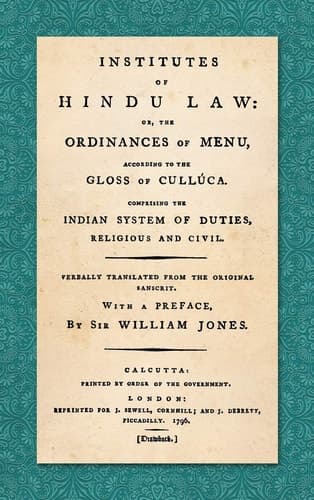
Institutes of Hindu Law, Or, The Ordinances of Manu, According to the Gloss of Cullúca, Comprising the Indian System of Duties, Religious, and Civil
William JonesPublished2007
Pages366
Formathardcover
PublisherThe Lawbook Exchange, Ltd.
Synopsis
The Manusmriti, or Laws of Manu, is an important statement of Hindu law. Attributed to Manu, the progenitor of humanity in Hindu theology, it was compiled in its final form around 200 BCE. It is a collection of laws governing individuals, communities and nations and is an important (and somewhat controversial) source of information about the caste system and the status of women.
This work achieved its international prominence through Jones [1746-1794], the able judge of the High Court of Calcutta and brilliant linguist, who produced the first complete English translation. Jones was attracted to this work because of its structural similarities to the Institutes of Justinian. Intending to establish Manu as the "Justinian of India," he planned to follow this translation with translations of other texts that resembled other parts of the Corpus Juris Civilis. He did not live long enough to complete his great project. With a new introduction by Steve Sheppard, William Enfield Professor of Law, University of Arkansas School of Law. xvi, 366 pp.
Recommendations

The Early Upanishads Annotated Text and Translation
by Patrick Olivelle
Olivelle's comparative legal scholarship directly engages with Jones's project of positioning Manu alongside Justinian's Institutes, but with modern textual criticism that challenges some of Jones's interpretive choices. If you found yourself curious about the actual historical context and reliability of Jones's translation, this scholarly work reads like a conversation with the text you just finished—examining the same legal frameworks but with contemporary rigor.
View book
Visions of the East Orientalism in Film
by Matthew Bernstein
This is your surprise pick—it's intellectual history rather than primary legal text, but Buruma examines figures like Jones himself, exploring how 18th-century European scholars constructed their understanding of 'the Orient' through translation and interpretation. You'll recognize Jones as a character in this larger narrative about knowledge, power, and the assumptions embedded in how one culture translates another's foundational texts.
View book
Palliative Care and Communication (Facing Death)
by The
Since you've engaged with Manu's religious and civil law framework, Kautilya's treatise on statecraft and economics offers the complementary perspective—where Manu emphasizes dharma and duty, the Arthashastra is pragmatic, almost Machiavellian in its approach to governance and power. The two texts were written in roughly the same period but represent fundamentally different philosophical approaches to ordering society.
View book
The Digest of Justinian
by Alan Watson
Jones's entire project was built on the structural parallel between Manu and Justinian's legal codes, but you've only read one side of the equation. Reading the actual Digest (in a modern translation like Birks and McLeod's) will show you exactly what Jones saw—how two ancient legal systems, separated by geography and theology, arrived at remarkably similar solutions for organizing human conduct and community obligations.
View book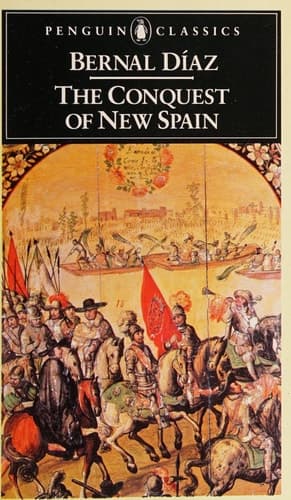
The Conquest of New Spain
by Bernal Diaz Del Castillo
A 16th-century eyewitness account that functions as a kind of ethnographic-legal document—Díaz describes Aztec law, governance, and social order while simultaneously narrating conquest. It's a fascinating counterpoint to Jones's scholarly distance: here you see what happens when one legal system encounters another not through translation but through violence, and how the victor's account becomes the historical record, much like Jones's translation became the definitive English version of Manu.
View bookAbout William Jones
Biography coming soon.
View author page