Synopsis
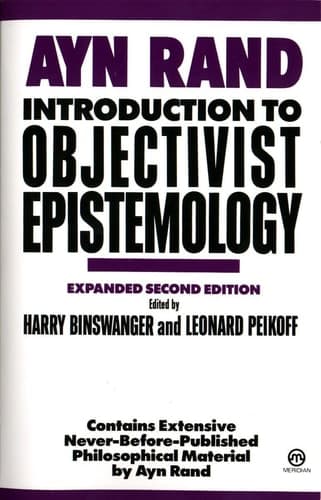
Today man's mind is under attack by all the leading schools of philosophy. We are told that we cannot trust our senses, that logic is arbitrary, that concepts have no basis in reality. Ayn Rand opposes that torrent of nihilism, and she provides the alternative in this eloquent presentation of the essential nature--and power--of man's conceptual faculty. She offers a startlingly original solution to the problem that brought about the collapse of modern philosophy: the problem of universals. This brilliantly argued, superbly written work, together with an essay by philosophy professor Leonard Peikoff, is vital reading for all those who seek to discover that human beings can and should live by the guidance of reason.
Recommendations
Generating recommendations…
Our AI is preparing recommendations for Introduction to Objectivist Epistemology Expanded Second Edition. This usually takes under a minute.
About Ayn Rand
A
Ayn Rand
1905–1982
Alice O'Connor (born Alisa Zinovyevna Rosenbaum;[a] February 2, [O.S. January 20] 1905 – March 6, 1982), better known by her pen name Ayn Rand (/aɪn/), was a Russian-American writer and philosopher. She is known for her fiction and for developing a philosophical system she named Objectivism. Born and educated in Russia, she moved to the United States in 1926. She wrote a play that opened on Broadway in 1935. After two early novels that were initially unsuccessful, she achieved fame with her 1943 novel, The Fountainhead. In 1957, Rand published her best-known work, the novel Atlas Shrugged. Afterward, until her death in 1982, she turned to non-fiction to promote her philosophy, publishing her own periodicals and releasing several collections of essays. Rand advocated reason as the only means of acquiring knowledge; she rejected faith and religion. She supported rational and ethical egoism and rejected altruism. In politics, she condemned the initiation of force as immoral[5][6] and opposed collectivism, statism, and anarchism. Instead, she supported laissez-faire capitalism, which she defined as the system based on recognizing individual rights, including property rights. Although Rand opposed libertarianism, which she viewed as anarchism, she is often associated with the modern libertarian movement. In art, Rand promoted romantic realism. She was sharply critical of most philosophers and philosophical traditions known to her, except for Aristotle, Thomas Aquinas and classical liberals. Rand's fiction received mixed reviews from literary critics.[ Although academic interest in her ideas has grown since her death, academic philosophers have generally ignored or rejected her philosophy because of her polemical approach and lack of methodological rigor.[4] Her writings have influenced some libertarians and conservatives politically. The Objectivist movement attempts to spread her ideas, both to the public and in academic settings
View author page