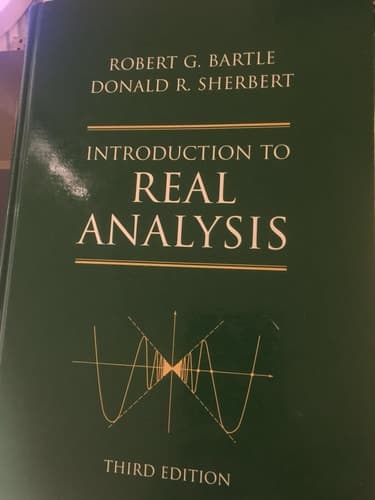
Introduction to Real Analysis, 3rd Edition
Robert G. BartlePublished1999
Pages388
Formathardcover
PublisherWiley
Synopsis
In recent years, mathematics has become valuable in many areas, including economics and management science as well as the physical sciences, engineering and computer science. Therefore, this book provides the fundamental concepts and techniques of real analysis for readers in all of these areas. It helps one develop the ability to think deductively, analyze mathematical situations and extend ideas to a new context. Like the first two editions, this edition maintains the same spirit and user-friendly approach with some streamlined arguments, a few new examples, rearranged topics, and a new chapter on the Generalized Riemann Integral.
Recommendations
Principles of Mathematical Analysis
by Walter Rudin
Rudin takes the same foundational material Bartle covers but approaches it with almost austere elegance—every proof is stripped to its essential logical skeleton. If you found yourself enjoying the deductive architecture of real analysis, Rudin's famous terseness will feel like watching a master craftsman work; there's no wasted motion, just pure mathematical reasoning.
View book
A Mathematician's Apology
by G. H. Hardy
This 1940 essay is a surprising pivot from textbooks, but it's essential reading for anyone who's just spent time with real analysis—Hardy writes like he's thinking aloud about *why* mathematics matters at all, and he's genuinely wrestling with whether pure mathematics has value beyond its beauty. It's philosophical rather than technical, but it'll deepen how you think about the subject you just studied.
View book
Elementary Differential Topology
by James R. Munkres
Munkres builds naturally from the real analysis you've just mastered—he takes those concepts of limits, continuity, and convergence and shows you the larger abstract structure they're part of. His writing style is similarly clear and methodical to Bartle's, but topology opens up a whole new way of thinking about what 'closeness' and 'continuity' really mean beneath the surface.
View book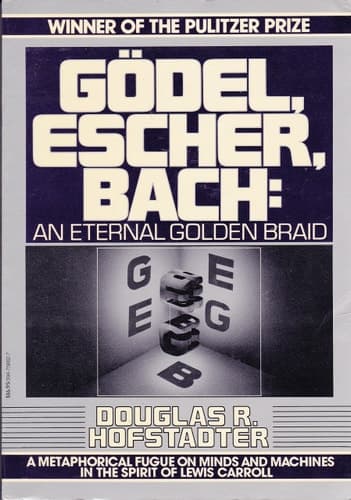
Gödel, Escher, Bach: An Eternal Golden Braid
by Douglas Hofstadter
Here's your surprise recommendation: Hofstadter weaves together mathematics, art, and music to explore self-reference and formal systems in ways that will make you reconsider what you've just learned about mathematical foundations. It's playful and sometimes maddening, but if real analysis taught you to think deductively, this book will show you the strange loops that emerge when logical systems start talking about themselves.
View book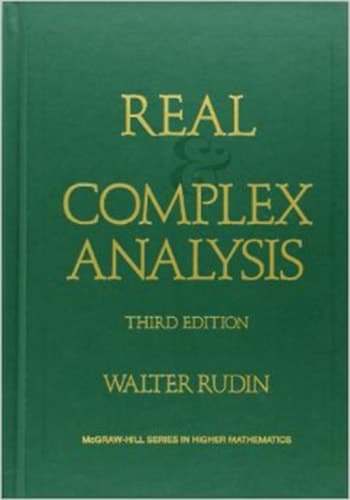
Real and Complex Analysis (Higher Mathematics Series)
by Walter Rudin
Wait—I know I recommended Rudin already, but this is a different book that serves as the natural next step. Rudin extends real analysis into the complex plane and functional analysis, maintaining that same crystalline logical structure but now you're working with richer mathematical objects. It's challenging, but you've built exactly the right foundation with Bartle to appreciate Rudin's approach here.
View bookAbout Robert G. Bartle
R
Robert G. Bartle
Born 1927
Biography coming soon.
View author page