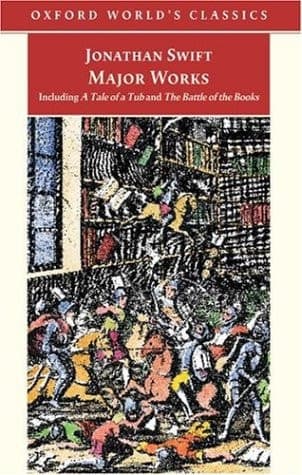
Jonathan Swift Major Works
Jonathan SwiftPublished2003
Pages722
Formatpaperback
PublisherOxford University Press
Synopsis
This authoritative edition brings together a unique selection from the full range of Swift's fifty-year career--prose, poetry, and letters--to give the essence of his work and thinking. Jonathan Swift (1667-1745) is best known as the author of Gulliver's Travels, which alone would have secured his place in the history of English literature. But in addition to this classic fictional satire, Swift wrote numerous works concerning politics, religion, and Ireland, some savage, others humorous, all suffused with his tremendous wit and inventiveness. This anthology includes satirical works such as A Tale of a Tub and The Battle of the Books, political pamphlets, pieces for the popular press, poems, and a generous selection from Swift's correspondence. Presented chronologically, the anthology offers a new and clearer awareness of the unity as well as the complexity of Swift's vision, and the powerful bonds between disparate pieces.
Recommendations
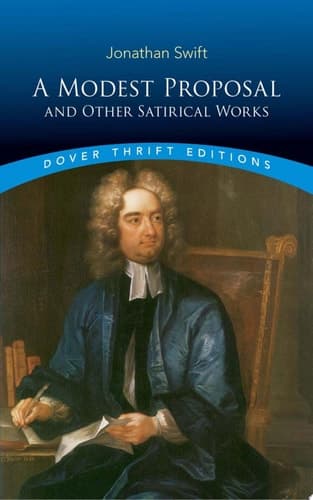
A Modest Proposal and Other Satirical Works
by Jonathan Swift
Shaw shares Swift's gift for weaponizing absurdity to expose social hypocrisy, but where Swift's satire cuts like a scalpel, Shaw deploys it like a sledgehammer wrapped in charm. His prefaces and shorter works have that same quality of making you laugh while your stomach turns at what you're actually reading about—the difference is Shaw's targets are Victorian society rather than 18th-century politics, giving you fresh ground to recognize the same human follies.
View book
Laurence Sterne, "Tristram Shandy"
by Anne Dromart
Published just after Swift's death, this novel is what happens when an 18th-century writer decides narrative itself is the joke—digressions become the plot, typography becomes meaning, and the author constantly winks at you from the margins. If you appreciated Swift's playfulness with form in *A Tale of a Tub*, Sterne takes that impulse and builds an entire novel around it, creating something that feels oddly modern despite being nearly 300 years old.
View book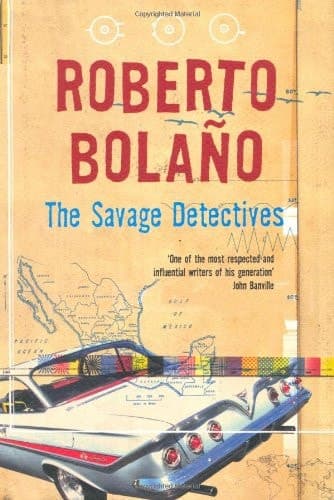
The Savage Detectives A Novel
by Roberto Bolaño
Here's the surprise: this sprawling, chaotic novel about poets and bohemians shares Swift's obsession with documenting the ridiculous pretensions of intellectual life, but through a postmodern lens that makes Swift's satire feel like a direct ancestor. Bolaño's characters are as deluded and self-important as Swift's dunces, but he treats them with a strange tenderness alongside the mockery—it's what Swift might have written if he'd lived to see the 20th century.
View book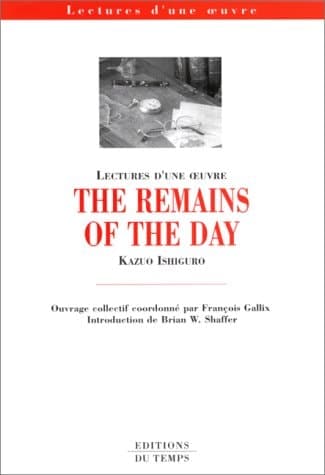
The remains of the day de Kazuo Ishiguro
by Gallix/François
Ishiguro's narrator is a man constructed entirely of self-deception and propriety, and the novel's genius—like Swift's—is that it makes you complicit in seeing through the character's blindness without ever breaking the surface politeness. The unreliable narrator technique here echoes Swift's use of persona in works like *A Modest Proposal*, where the horror emerges from what's *not* being said, from the gap between what the speaker believes and what's actually true.
View bookAbout Jonathan Swift
J
Jonathan Swift
1667–1745
Jonathan Swift was an Irish satirist, essayist, political pamphleteer (first for the Whigs, then for the Tories), poet and cleric who became Dean of St. Patrick's, Dublin. He is remembered for works such as Gulliver's Travels, A Modest Proposal, A Journal to Stella, Drapier's Letters, The Battle of the Books, An Argument Against Abolishing Christianity, and A Tale of a Tub. Source and more information: https://en.wikipedia.org/wiki/Jonathan_Swift
View author page