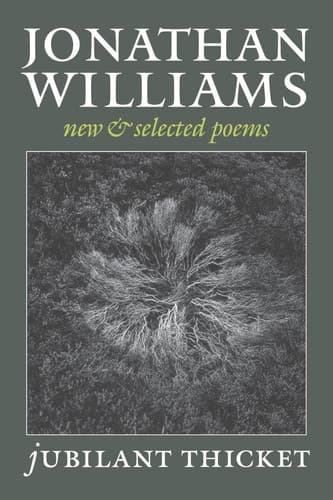
Jubilant Thicket: New and Selected Poems
Jonathan WilliamsPublished2004
Pages360
Formatpaperback
PublisherCopper Canyon Press
Synopsis
"Jubilant Thicket teems with the eccentric, strange, and boundlessly authentic - neoclassical poems, social satire, musical suites, limericks and lyrics. There is spleen, salt, and a delicious sarcasm, as Williams finds inspiration in Mahler and Mojo Nixon, William Blake and whimmy-diddles. Always in knowing command, he serves up an admixture of "found" and vernacular language, invented and archaic forms, jokes, shock, literary allusions, and political disgust."--Jacket.
Recommendations
The Odes of Horace
by Horace
Williams draws heavily on classical forms and allusions, and Ferry's translation captures that same irreverent wit—Horace was essentially the Roman poet doing exactly what Williams does: mixing high literary ambition with vernacular speech, political barbs, and jokes that land because the craftmanship is impeccable. You'll recognize Williams's DNA here, but experiencing the original source material will deepen your appreciation for how he's playing with these forms.
View book
The Style of Connectedness Gravity's Rainbow and Thomas Pynchon
by Thomas Moore
I know this seems like the opposite direction—a massive, dense novel versus poetry—but Pynchon shares Williams's obsession with found language, historical fragments, and the absurdity lurking in technical jargon and pop culture. Both writers refuse to choose between 'high' and 'low' art; they're equally comfortable with a Mahler reference and a dirty joke in the same breath. The paranoia and sarcasm will feel familiar, just operating at a different scale.
View book
The Book of Disquiet
by Fernando Pessoa
Pessoa's fragmented, aphoristic prose-poetry collection shares Williams's love of invented personas and linguistic invention—except Pessoa takes it further, creating multiple heteronyms with entirely different poetic voices. Like Williams, he's endlessly inventive with form, mixing philosophy with mundane observation, and there's that same quality of being 'in knowing command' while appearing utterly eccentric. It's a different language and sensibility, but the DNA is recognizable.
View book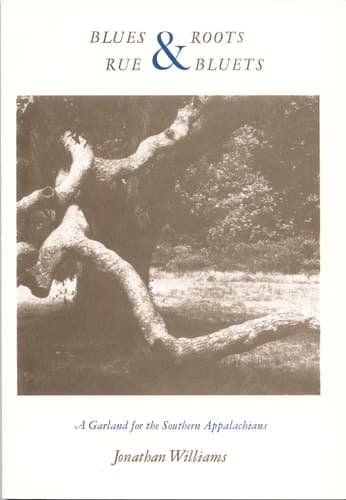
Blues and Roots/Rue and Bluets A Garland for the Southern Appalachians
by Jonathan Williams
Nelson does something Williams does constantly: she refuses to stay in one genre or tone, mixing scholarly footnotes with lyric fragments, color theory with heartbreak, high theory with vernacular confession. Her use of numbered sections and collage-like construction echoes Williams's musical suites and found-language approach, but she's working through contemporary theory and queer experience. It's contemporary poetry that has that same 'delicious sarcasm' wrapped around genuine intellectual ambition.
View bookAbout Jonathan Williams
Biography coming soon.
View author page