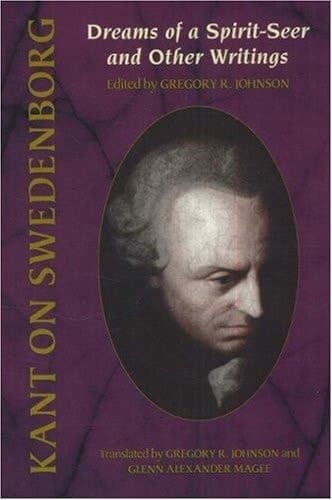
KANT ON SWEDENBORG: DREAMS OF A SPIRIT-SEER & OTHER WRITINGS (SWEDENBORG STUDIES)
Immanuel KantPublished2003
Pages238
Formatpaperback
PublisherSwedenborg Foundation Publishers
Synopsis
Dreams of a Spirit-Seer, Immanuel Kant's book on Emanuel Swedenborg, has mystified readers since its publication in 1766 during Swedenborg's lifetime. The unusual style and content of Dreams have given rise to two opposing interpretations. Most Kant scholars regard the work as a skeptical attack on Swedenborg's mysticism. Other critics, however, believe that Kant regarded Swedenborg as a serious philosopher and visionary, and that Dreams both reveals Kant's profound debt to Swedenborg and coneals that debt behind the mask of irony.
In addition, Dr. Gregory R. Johnson provides selections from other Kantian writings that mention Swedenborg and also contemporary reviews of Dreams, showing that Kant himself was ambivalent about Swedenborg's claims and that readers of his day questioned his position.
With its extensive notes, this work is an invaluable resource for students of Kant and of Swedenborg.
Recommendations
Generating recommendations…
Our AI is preparing recommendations for KANT ON SWEDENBORG: DREAMS OF A SPIRIT-SEER & OTHER WRITINGS (SWEDENBORG STUDIES). This usually takes under a minute.
About Immanuel Kant
I
Immanuel Kant
1724–1804
Immanuel Kant was an 18th-century German philosopher from the Prussian city of Königsberg. Kant was the last influential philosopher of modern Europe in the classic sequence of the theory of knowledge during the Enlightenment beginning with thinkers John Locke, George Berkeley, and David Hume. Kant created a new perspective in philosophy which had widespread influences on philosophy continuing through to the 21st century. He published important works on epistemology, as well as works relevant to religion, law, and history. One of his most prominent works is the *Critique of Pure Reason*, an investigation into the limitations and structure of reason itself. It encompasses an attack on traditional metaphysics and epistemology, and highlights Kant's own contribution to these areas. The other main works of his maturity are the *Critique of Practical Reason*, which concentrates on ethics, and the *Critique of Judgment*, which investigates aesthetics and teleology. <sup>[1][1]</sup> [1]: https://en.wikipedia.org/wiki/Immanuel_Kant
View author page