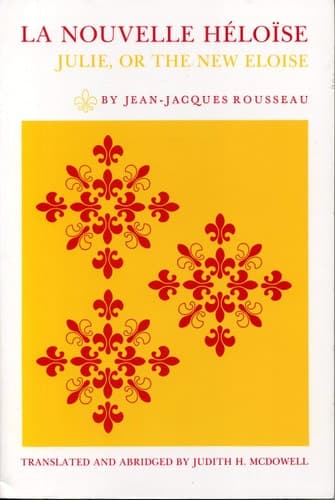
La Nouvelle Héloïse: Julie, or the New Eloise : Letters of Two Lovers, Inhabitants of a Small Town at the Foot of the Alps
Jean-Jacques RousseauPublished1986
Pages432
Formatpaperback
PublisherThe Pennsylvania State University Press
Synopsis
This landmark of the romantic movement not only greatly influenced the taste and morality of the eighteenth-century reading public but was also one of the most seminal and widely read literary works of its day. Seventy-two editions of the novel in French appeared between 1761 and 1800, and though Voltaire called its success one of the infamies of the century. It won for Rousseau a place beside the author of Candide as a director of European thought. The plot of the novel is one familiar to all literature; that of a fallen and regenerated woman. The first three parts are devoted to the celebration of the passionate, mutual love of Saint-Preux and Julie; the last three praise Julie's return to virtue as a faithful wife and dedicated mother. Professor McDowell's translation is precise but natural and conveys to the reader the distinctive flavor of Rousseau's style.
Recommendations
Generating recommendations…
Our AI is preparing recommendations for La Nouvelle Héloïse: Julie, or the New Eloise : Letters of Two Lovers, Inhabitants of a Small Town at the Foot of the Alps. This usually takes under a minute.
About Jean-Jacques Rousseau
J
Jean-Jacques Rousseau
1712–1778
Jean-Jacques Rousseau was a major Genevois philosopher, writer, and composer of 18th-century Romanticism. His political philosophy influenced the French Revolution and the development of modern political, sociological and educational thought. His novel, *Emile: or, On Education*, which he considered his most important work, is a seminal treatise on the education of the whole person for citizenship. His sentimental novel, Julie, ou la nouvelle Héloïse, was of great importance to the development of pre-Romanticism and romanticism in fiction. Rousseau's autobiographical writings: his *Confessions*, which initiated the modern autobiography, and his *Reveries of a Solitary Walker* were among the pre-eminent examples of the late 18th-century movement known as the "Age of Sensibility", featuring an increasing focus on subjectivity and introspection that has characterized the modern age. Rousseau also made important contributions to music as a theorist. During the period of the French Revolution, Rousseau was the most popular of the philosophers among members of the Jacobin Club. He was interred as a national hero in the Panthéon in Paris, in 1794, 16 years after his death.<sup>[1][1]</sup> [1]: http://en.wikipedia.org/wiki/Jean-Jacques_Rousseau
View author page