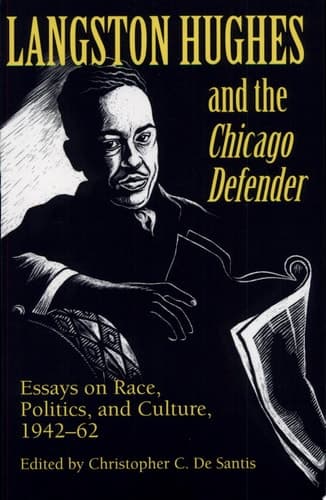
Langston Hughes and the *Chicago Defender* Essays on Race, Politics, and Culture, 1942-62
Langston HughesPublished1995
Pages261
Formatpaperback
PublisherUniversity of Illinois Press
Synopsis
Langston Hughes is well known as a poet, playwright, novelist, social activist, communist sympathizer, and brilliant member of the Harlem Renaissance. He has been referred to as the "Dean of Black Letters" and the "poet low-rate of Harlem." But it was as a columnist for the famous African-American newspaper the Chicago Defender that Hughes chronicled the hopes and despair of his people. For twenty years, he wrote forcefully about international race relations, Jim Crow, the South, white supremacy, imperialism and fascism, segregation in the armed forces, the Soviet Union and communism, and African-American art and culture. None of the racial hypocrisies of American life escaped his searing, ironic prose.
This is the first collection of Hughes's nonfiction journalistic writings. For readers new to Hughes, it is an excellent introduction; for those familiar with him, it gives new insights into his poems and fiction.
Recommendations
Generating recommendations…
Our AI is preparing recommendations for Langston Hughes and the *Chicago Defender* Essays on Race, Politics, and Culture, 1942-62. This usually takes under a minute.
About Langston Hughes
L
Langston Hughes
1902–1967
Langston Hughes (1902-1967) Writer, editor, lecturer Langston Hughes achieved fame as a poet during the burgeoning of the arts known as the Harlem Renaissance, but those who label him "a Harlem Renaissance poet" have restricted his fame to only one genre and decade. In addition to his work as a poet, Hughes was a novelist, columnist, playwright, and essayist, and though he is most closely associated with Harlem, his world travels influenced his writing in a profound way. Langston Hughes followed the example of Paul Laurence Dunbar, one of his early poetic influences, to become the second African American to earn a living as a writer. His long and distinguished career produced volumes of diverse genres and inspired the work of countless other African American writers. --From Gale Cengage Learning Free resources
View author page