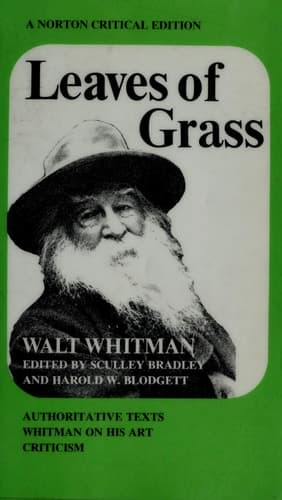
Leaves of Grass : Authoritative Texts, Prefaces, Whitman on His Art, Criticism
Walt WhitmanPublished1973
Pages1008
Formatpaperback
PublisherNew York
Synopsis
Leaves of Grass, first published in 1855, contained twelve long untitled poems, but Whitman continued to expand it throughout his life.Whitman's poetry was unprecedented in its unapologetic joy in the physical and its inextricable link to the spiritual. As Ralph Waldo Emerson wrote to "I am very happy in reading [ Leaves of Grass ], as great power makes us happy ... I find incomparable things said incomparably well, as they must be."
Recommendations
Generating recommendations…
Our AI is preparing recommendations for Leaves of Grass : Authoritative Texts, Prefaces, Whitman on His Art, Criticism. This usually takes under a minute.
About Walt Whitman
W
Walt Whitman
1819–1892
Walt Whitman was an American poet, essayist, journalist, and humanist. He was a part of the transition between Transcendentalism and realism, incorporating both views in his works. Whitman is among the most influential poets in the American canon, often called the father of free verse.[1] His work was very controversial in its time, particularly his poetry collection Leaves of Grass, which was described as obscene for its overt sexuality. ([Source][1].) [1]:https://en.wikipedia.org/wiki/Walt_Whitman
View author page