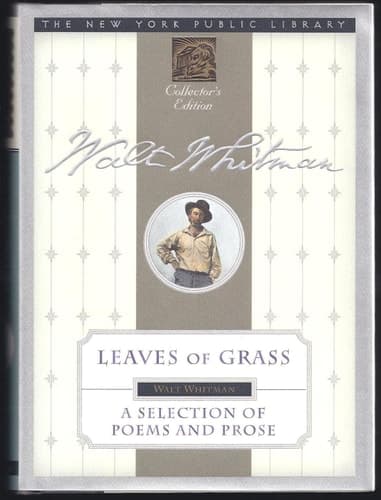
Leaves of Grass: New York Public Library Collector's Edition (New York Public Library Collector's Editions)
Walt WhitmanPublished1997
Pages416
Formathardcover
PublisherDoubleday
Synopsis
Abraham Lincoln read it with approval, but Emily Dickinson described its bold language and themes as "disgraceful." Ralph Waldo Emerson found it "the most extraordinary piece of wit and wisdom that America has yet produced." Published at the author's expense on July 4, 1855, Leaves of Grass inaugurated a new voice and style into American letters and gave expression to an optimistic, bombastic vision that took the nation as its subject. Unlike many other editions of Leaves of Grass, which reproduce various short, early versions, this Modern Library Paperback Classics "Death-bed" edition presents everything Whitman wrote in its final form, and includes newly commissioned notes.
From the Trade Paperback edition.
Recommendations
Generating recommendations…
Our AI is preparing recommendations for Leaves of Grass: New York Public Library Collector's Edition (New York Public Library Collector's Editions). This usually takes under a minute.
About Walt Whitman
W
Walt Whitman
1819–1892
Walt Whitman was an American poet, essayist, journalist, and humanist. He was a part of the transition between Transcendentalism and realism, incorporating both views in his works. Whitman is among the most influential poets in the American canon, often called the father of free verse.[1] His work was very controversial in its time, particularly his poetry collection Leaves of Grass, which was described as obscene for its overt sexuality. ([Source][1].) [1]:https://en.wikipedia.org/wiki/Walt_Whitman
View author page