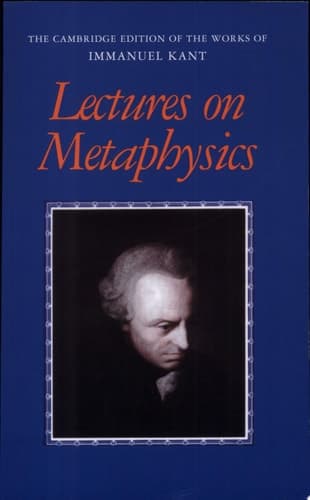
Lectures on Metaphysics
Immanuel KantPublished2001
Pages642
Formatpaperback
PublisherCambridge University Press
Synopsis
The purpose of the Cambridge Edition is to offer translations of the best modern German edition of Kant's work in a uniform format suitable for Kant scholars. When complete (fourteen volumes are currently envisaged) the edition will include all of Kant's published writings and a generous selection from the unpublished writings such as the Opus postumum, handschriftliche Nachlass, lectures, and correspondence. This volume contains the first translation into English of notes from Kant's lectures on metaphysics. These lectures, dating from the 1760s to the 1790s, touch on all the major topics and phases of Kant's philosophy. Most of these notes have appeared only recently in the German Academy Edition; this translation offers many corrections of that edition. As is standard with the volumes in the Cambridge Edition there is an extensive editorial apparatus, including extensive linguistic and explanatory notes, a detailed subject index, and glossaries of key terms.
Recommendations
Generating recommendations…
Our AI is preparing recommendations for Lectures on Metaphysics. This usually takes under a minute.
About Immanuel Kant
I
Immanuel Kant
1724–1804
Immanuel Kant was an 18th-century German philosopher from the Prussian city of Königsberg. Kant was the last influential philosopher of modern Europe in the classic sequence of the theory of knowledge during the Enlightenment beginning with thinkers John Locke, George Berkeley, and David Hume. Kant created a new perspective in philosophy which had widespread influences on philosophy continuing through to the 21st century. He published important works on epistemology, as well as works relevant to religion, law, and history. One of his most prominent works is the *Critique of Pure Reason*, an investigation into the limitations and structure of reason itself. It encompasses an attack on traditional metaphysics and epistemology, and highlights Kant's own contribution to these areas. The other main works of his maturity are the *Critique of Practical Reason*, which concentrates on ethics, and the *Critique of Judgment*, which investigates aesthetics and teleology. <sup>[1][1]</sup> [1]: https://en.wikipedia.org/wiki/Immanuel_Kant
View author page