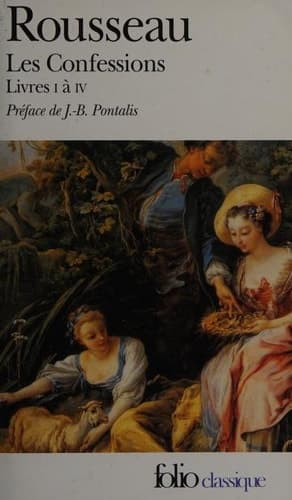
Les Confessions Livres I à IV
Jean-Jacques RousseauPublished1997
Pages265
Formatpaperback
PublisherGallimard
Synopsis
Dans ces quatre premiers livres de ses Confessions, Rousseau raconte sa jeunesse, de sa naissance (1712) jusqu'à l'âge de 19 ans (1731). Il y retrace son enfance difficile à Genève - lui, le fils d'un modeste horloger, orphelin de mère - et sa fuite pour échapper à son milieu ; ses voyages ; enfin sa rencontre providentielle avec Mme de Warens, une femme plus âgée dont il tombe immédiatement amoureux. Ce sera pour lui une nouvelle naissance, et l'entrée dans l'âge adulte. Plus de trente ans après, Rousseau se penche sur Jean-Jacques. Il raconte ses chagrins d'enfant, ses joies d'adolescent, avoue ses petits larcins («j'ai donc été fripon»), revit ses premiers émois amoureux, replonge dans sa découverte éblouie de la lecture, qui le sauve de l'ennui («je ne choisissais point : je lisais tout avec une égale avidité»). Il fait, en somme, le bilan de son apprentissage de la vie. Dans cette extraordinaire quête d'une identité, véritable roman des origines, Rousseau se raconte, Rousseau se réinvente.
Recommendations
The Way of All Flesh
by Samuel Butler
Butler's protagonist Ernest Pontifex undergoes the same painful excavation of his own origins that Rousseau performs—examining how his family, upbringing, and early mistakes shaped him into who he became. Like Rousseau, Butler writes with unflinching honesty about childhood humiliation and the slow, often uncomfortable process of becoming oneself, but with a sharp satirical edge that makes the self-examination darkly comic rather than purely introspective.
View book
Die Wiederkehr der Zeichen: Eine psychoanalytische Studie zu Knut Hamsuns «Hunger» (Texte und Untersuchungen zur Germanistik und Skandinavistik) (German Edition)
by Thomas Fechner-Smarsly
Hamsun's unnamed narrator spirals through Oslo documenting his mental and emotional states with the same raw, unfiltered intensity Rousseau brings to his confessions—but where Rousseau seeks to understand his past, Hamsun captures the disorienting present moment of a consciousness fragmenting in real time. Both writers refuse to present a polished self; instead, they show us the contradictions, the shame, the inexplicable impulses that make up an actual human being.
View book
The Savage Detectives A Novel
by Roberto Bolaño
This is the surprise pick: where you might expect another 18th-century memoir, Bolaño gives you something structurally radical—a novel that's part coming-of-age story, part literary mystery, told through overlapping voices and fragmented narratives. Like Rousseau, it's obsessed with tracing how a person becomes who they are, but Bolaño scatters that origin story across hundreds of pages and multiple perspectives, making the reader do the detective work of assembling identity from fragments.
View book
Dichtung und Umwelt von Gilgamesch bis zu den 'Physikern' : das Sprachkunstwerk zwischen Erde, Leib und Geist
by Rudolf Kreis
Goethe's own autobiography, written decades after the events it describes, shares Rousseau's project of retrospective self-invention—examining how a young man's encounters with literature, love, and mentors shaped his artistic consciousness. Where Rousseau emphasizes emotional authenticity, Goethe is more concerned with how experience becomes transformed into art, making this a natural companion that shows you how another towering figure of the era approached the same fundamental question: who was I, and how did I become myself?
View bookAbout Jean-Jacques Rousseau
J
Jean-Jacques Rousseau
1712–1778
Jean-Jacques Rousseau was a major Genevois philosopher, writer, and composer of 18th-century Romanticism. His political philosophy influenced the French Revolution and the development of modern political, sociological and educational thought. His novel, *Emile: or, On Education*, which he considered his most important work, is a seminal treatise on the education of the whole person for citizenship. His sentimental novel, Julie, ou la nouvelle Héloïse, was of great importance to the development of pre-Romanticism and romanticism in fiction. Rousseau's autobiographical writings: his *Confessions*, which initiated the modern autobiography, and his *Reveries of a Solitary Walker* were among the pre-eminent examples of the late 18th-century movement known as the "Age of Sensibility", featuring an increasing focus on subjectivity and introspection that has characterized the modern age. Rousseau also made important contributions to music as a theorist. During the period of the French Revolution, Rousseau was the most popular of the philosophers among members of the Jacobin Club. He was interred as a national hero in the Panthéon in Paris, in 1794, 16 years after his death.<sup>[1][1]</sup> [1]: http://en.wikipedia.org/wiki/Jean-Jacques_Rousseau
View author page