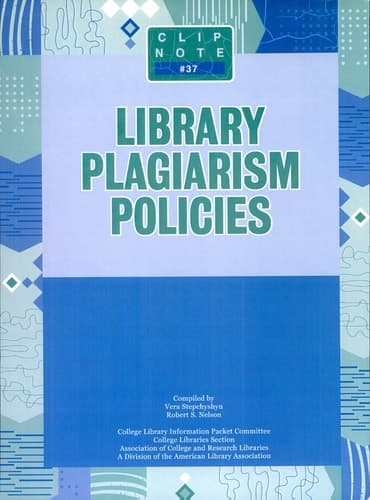
Library Plagiarism Policies
Vera StepchyshynPublished2007
Pages128
Formatpaperback
PublisherAssoc of Cllge & Rsrch Libr
Synopsis
This is a pragmatic resource for college libraries, their faculty, their staff, and their administrators to use to develop policies on the prevention and detection of plagiarism. The task of plagiarism prevention and detection is often perceived within the auspices of the college librarian. The college librarian is well versed in web and electronic resource searching, and has the skill-base needed to quickly and effectively retrieve evidence of plagiarism.While the use of the librarian as a plagiarism prevention and detection resource is on the rise, the number of libraries that have formalized, through policy statements or other documents, the responsibilities of librarians is still relatively small and for good reason. The study gathered data and documents from small college libraries and presents them for the reader's consideration when examining the issue of student plagiarism and its relationship to the college library.Survey questions covered general information, policy information, librarian responsibilities/activities, incidents and action, and personal/professional experiences. This study was conducted to determine what, if anything, is available that may serve as a model
Recommendations
The Craft of Research
by Wayne C. Booth
You've just finished a methodical examination of how institutions actually *implement* policy, and this book takes that same pragmatic approach but zooms out to the research process itself. Booth and colleagues walk through the detective work of finding evidence and building arguments—essentially the intellectual scaffolding behind what Stepchyshyn documents librarians doing in practice. It's the companion volume that explains the 'why' behind the 'how.'
View book
Well Planned Garden
by Sue Phillips
Fitzpatrick examines how academic institutions resist change and innovation—a perfect counterpoint to Stepchyshyn's work on plagiarism policy adoption. Where Stepchyshyn documents what libraries *are* doing, Fitzpatrick explores why institutions struggle to do things differently. She writes with the same evidence-based approach but focuses on the structural barriers that keep even well-intentioned reforms from taking root.
View book
The Midnight Library A Novel
by Matt Haig
This is the surprise pick—a philosophical fiction that explores choices and consequences in ways that actually resonate with academic integrity work. The protagonist navigates parallel versions of her life based on different decisions, which mirrors the branching outcomes Stepchyshyn's research reveals: different plagiarism policies create different institutional cultures. It's contemplative rather than procedural, but it asks the same underlying question: what happens when we choose one path over another?
View book
Women and Minority Faculty in the Academic Workplace
by Adalberto Aguirre Jr.
Published in 2000, this gives you a different-decade perspective on how college institutions actually function—predating Stepchyshyn's 2007 work. Kezar examines the culture and politics of academic workplaces with the same survey-based, data-driven approach you just read, but focuses on faculty and staff dynamics rather than plagiarism specifically. It's like reading the broader institutional context that makes plagiarism policy necessary.
View book
When Fish Fly Lessons For Creating a Vital and Energized Workplace From the World Famous Pike Place Fish Market
by John Yokoyama
Rather than abstract policy frameworks, Chace grounds the plagiarism conversation in a specific, high-profile case that forced institutional reckoning. He writes with the precision of someone examining actual institutional failure, showing how the absence of clear policies and librarian involvement creates crises. It's Stepchyshyn's work viewed through the lens of what happens when institutions *don't* have the systems she's advocating for.
View bookAbout Vera Stepchyshyn
Biography coming soon.
View author page