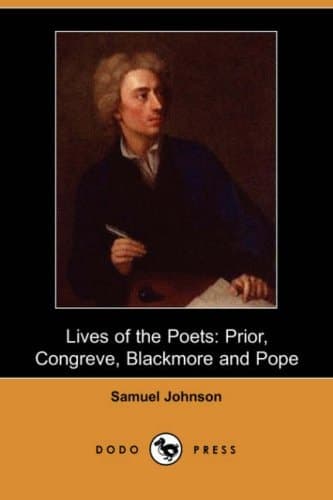
Lives of the Poets Prior, Congreve, Blackmore and Pope
Samuel JohnsonPublished2007
Pages152
Formatpaperback
PublisherDodo Press
Synopsis
Samuel Johnson (1709-1784), often referred to simply as Dr Johnson, was one of England's greatest literary figures: a poet, essayist, biographer, lexicographer and a critic of English literature. He was also a great wit and prose stylist, well known for his aphorisms. Between 1745 and 1755, Johnson wrote perhaps his best-known work, A Dictionary of the English Language. During the decade he worked on the Dictionary, Johnson, needing to augment his precarious income, also wrote a series of semi-weekly essays under the title The Rambler. These essays, often on moral and religious topics, tended to be more grave than the title of the series would suggest. They ran until 1752. Initially they were not popular, but once collected as a volume they found a large audience. Johnson's final major work was his Lives of the Poets (1781), comprising short biographies of about 50 English poets, most of whom were alive in the eighteenth century. Amongst his other works are The Idler (1758-1760), Rasselas, Prince of Abissinia (1759) and The Patriot (1774).
Recommendations
Generating recommendations…
Our AI is preparing recommendations for Lives of the Poets Prior, Congreve, Blackmore and Pope. This usually takes under a minute.
About Samuel Johnson
S
Samuel Johnson
1709–1784
Samuel Johnson, was an English author who made lasting contributions to English literature as a poet, essayist, moralist, literary critic, biographer, editor and lexicographer. Johnson was a devout Anglican and committed Tory, and has been described as "arguably the most distinguished man of letters in English history".[1] He is also the subject of "the most famous single work of biographical art in the whole of literature": James Boswell's Life of Samuel Johnson.[2] ([Source][1].) [1]:http://en.wikipedia.org/wiki/Samuel_Johnson
View author page