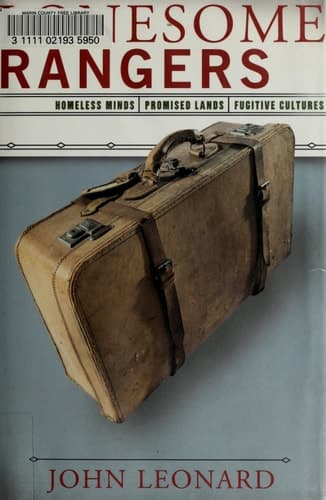
Lonesome Rangers Homeless Minds, Promised Lands, Fugitive Cultures
John LeonardPublished2002
Pages318
Formathardcover
PublisherNew Press
Synopsis
An exciting and far-reaching new book on writers and exile by the leading literary critic. John Leonard, "the fastest wit in the East" (The New York Times Book Review), is back with the off-beat, wide-ranging style that earned his last book, When the Kissing Had to Stop, a place among the Voice Literary Supplement's "25 Favorites of 1999." Now, with an eye to the social and political experience of writers, Leonard adopts a broad definition of exile. He addresses Robert Putnam's Bowling Alone, where exile manifests itself in solitary bowling, a reflection of a declining sense of community. He considers Salman Rushdie as rock'n'roll Orpheus, whoafter ten years in fatwa-enforced exilebears a striking resemblance to his continually disappearing characters. And Leonard also explores Primo Levi's exile of survival, Bruce Chatwin's self-imposed exile in travel, as well as the work of Saul Bellow, Ralph Ellison, Phillip Roth, Barbara Kingsolver, and Don DeLillo, among others. As always, Leonard's writing jumps off the page, engaging the reader in what the Washington Post calls his "laugh-out-loud magic with words."
Recommendations
Generating recommendations…
Our AI is preparing recommendations for Lonesome Rangers Homeless Minds, Promised Lands, Fugitive Cultures. This usually takes under a minute.
About John Leonard
J
John Leonard
Born 1939
Biography coming soon.
View author page