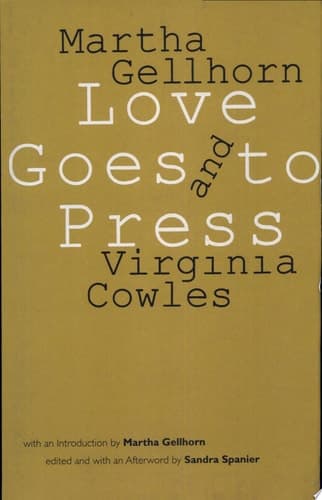
Love Goes to Press A Comedy in Three Acts
Martha GellhornPublished1995
Pages90
Formathardcover
PublisherU of Nebraska Press
Synopsis
"Who gets whom, and who gets there first makes for a laugh-aloud read of a very funny play."-Milton Wolff, the last commander of the Lincoln Battalion and author of Another Hill: An Autobiographical Novel Written immediately after the war, Love Goes to Press opened in London in June 1946 and in New York in January 1947. Then a relief for the survivors of Blitzkrieg and ration cards, it is now a devilishly entertaining portrayal of the Battle of the Sexes. This romantic farce, published here for the first time, is set on the Italian front in World War II, where two women war correspondents-smart, sexy, and famous for scooping their male competitors-struggle to balance their professional lives with their love lives. The American literary tradition is rife with stories of "men without women, " but in Love Goes to Press Gellhorn and Cowles have created a world of "women without men." The plot focuses on a pair of daring, quick-witted female buddies in bold pursuit of accomplishment and adventure while narrowly eluding the entanglements of marriage and domesticity. In her six-decade career as a war correspondent, Martha Gellhorn has covered the Spanish Civil War, World War II, and wars in Vietnam, the Middle East, and Central America. (In 1990, at the age of 81, she interrupted a snorkeling trip to Belize to witness the aftermath of the U.S. invasion of Panama; her report appeared in Granta.) Gellhorn has published fifteen books, including eight novels, short fiction, and two collections of journalistic articles. Virginia Spencer Cowles (1912-1983) also began her career as a war correspondent, and her eyewitness accounts of Europe at war appear in her book, Looking for Trouble, a bestsellerof 1941. She went on to write eleven more books of nonfiction. Sandra Spanier is an associate professor of English at the University of Nebraska-Lincoln; her afterword situates the play in its cultural context and in Gellhorn's career.
Recommendations
Generating recommendations…
Our AI is preparing recommendations for Love Goes to Press A Comedy in Three Acts. This usually takes under a minute.
About Martha Gellhorn
M
Martha Gellhorn
1908–1998
Martha Gellhorn was born in St. Louis, Missouri, the daughter of a suffragette and a gynecologist. In 1926 she graduated from John Burroughs School and then attended Bryn Mawr College in Philadelphia. In 1927, she left before graduating to pursue a career as a journalist. In 1930 she went to France for two years where she worked as a foreign correspondent for the United Press. While in Europe, she became active in the pacifist movement, which she wrote about in her first book, What Mad Pursuit (1934). Upon returning to the U.S., she worked as an investigator for the Federal Emergency Relief Administration, reporting on the impact of the Depression on the United States. Her reports caught the attention of Eleanor Roosevelt, and the two women became lifelong friends. In 1936, on a trip to Key West, she met the author Ernest Hemingway. They travelled together in Spain, where she was reporting on the Spanish Civil War for Collier's Weekly. Later, she reported on the rise of Adolf Hitler in Germany and in 1938 she was working in Czechoslovakia. She later reported the war from Finland, Hong Kong, Burma, Singapore and Britain. She was among the first journalists to report from Dachau concentration camp after it was liberated. She married Hemingway in 1940, but her career as a journalist kept travelling for long periods of time, and they divorced in 1945. After the war, she covered the Vietnam War, the Six-Day War in the Middle East, and the civil wars in Central America for the Atlantic Monthly. In 1949, she adopted a son from an Italian orphanage, and although she was briefly a devoted mother, she soon left him to the care of her relatives in Englewood, and he eventually ended up in boarding school. She married Tom Matthews, editor-in-chief of Time magazine, in 1954; they were divorced in 1963. Aged 81, she travelled impromptu to Panama, where she wrote on the U.S. invasion. Only when the Bosnian war broke out in the 1990s did she concede she was too old to continue her career as a war correspondent. She died in London in 1998, aged 89, taking her own life after a long battle with cancer and near total blindness. She is considered to be one of the greatest war correspondents of the 20th century. Gellhorn published a large number of books, including a collection of articles on war, The Face of War (1959), a novel about McCarthyism, The Lowest Trees Have Tops (1967), an account of her travels (including one trip with Ernest Hemingway), Travels With Myself and Another (1978) and a collection of her peacetime journalism, The View From the Ground (1988). Her selected letters were published posthumously in 2006.
View author page