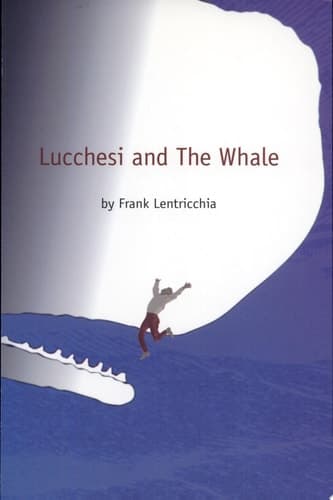
Lucchesi and The Whale
Frank LentricchiaPublished2003
Pages128
Formatpaperback
PublisherDuke University Press
Synopsis
Lucchesi and The Whale is an unusual work of fiction by noted author and critic Frank Lentricchia. Its central character, Thomas Lucchesi Jr., is a college professor in the American heartland whose obsessions and compulsions include traveling to visit friends in their last moments of life—because grief alone inspires him to write—and searching for secret meaning in Herman Melville’s Moby-Dick. Himself a writer of “stories full of violence in a poetic style,” Lucchesi tells his students that he teaches “only because [his] fiction is commercially untouchable” and to “never forget that.” Austerely isolated, anxiety-ridden, and relentlessly self-involved, Lucchesi nonetheless cannot completely squelch his eagerness for love.
Having become “a mad Ahab of reading,” who is driven to dissect the “artificial body of Melville’s behemothian book” to grasp its truth, Lucchesi allows his thoughts to wander and loop from theory to dream to reality to questionable memory. But his black humor-tinged musings are often as profoundly moving as they are intellectual, such as the section in which he ponders the life and philosophy of Ludwig Wittgenstein in relation to the significance of a name—and then attempts to share these thoughts with a sexy, middle-aged flight attendant—or another in which he describes a chance meeting with a similarly-named mafia don.
Despite apparent spiritual emptiness, Lucchesi in the end does find “a secret meaning” to Moby-Dick. And Lentricchia’s creations—both Lucchesi and The Whale and its main character—reveal this meaning through a series of ingeniously self-reflective metaphors, in much the way that Melville himself did in and through Moby-Dick. Vivid, humorous, and of unparalleled originality, this new work from Frank Lentricchia will inspire and console all who love and ponder both great literature and those who would write it.
Recommendations
The Mezzanine A Novel
by Nicholson Baker
Baker's novel unfolds entirely during one lunch hour, with a narrator whose mind spirals through digression, memory, and obsessive analysis of mundane objects—much like Lucchesi's looping thoughts that wander from theory to dream to reality. Both authors trust their readers to follow intellectual tangents that ultimately reveal something profound about consciousness and meaning-making itself.
View book
If on a Winter's Night a Traveler Introduction by Peter Washington
by Italo Calvino
Calvino's novel directly addresses you as a reader navigating fragmented narratives and incomplete stories, making the act of reading itself the subject—a perfect companion to Lucchesi's obsessive deconstruction of Moby-Dick. Like Lentricchia, Calvino plays with the boundary between literary criticism and creative fiction, turning analysis into art.
View book
The Savage Detectives A Novel
by Roberto Bolaño
Bolaño's sprawling novel follows obsessive intellectuals chasing literary mysteries across continents, their quests driven by the same compulsive need to uncover hidden meaning that consumes Lucchesi. The prose shifts between styles and perspectives with the same kind of restless intellectual energy, and both books treat failed ambition and isolation with dark humor and unexpected tenderness.
View book
Reading Marilynne Robinson's Housekeeping (Boise State University Western Writers Series)
by James H. Maguire
Robinson's 1980 novel offers something Lucchesi desperately seeks but cannot quite grasp—a meditation on love, belonging, and meaning that emerges quietly from observation rather than intellectual dissection. Where Lentricchia's character is all anxiety and theory, Robinson shows how grace arrives through acceptance, making this a surprisingly moving counterpoint to the novel you just finished.
View bookThe Savage Detectives A Novel
by Roberto Bolaño
Wallace's novella presents a narrator who, like Lucchesi, is brilliant, self-aware about his own neuroses, and trapped in the gap between intellectual understanding and emotional connection. The prose style mirrors thought itself—digressive, footnoted, wrestling with ideas—and Wallace captures that particular loneliness of the over-educated mind with both precision and surprising warmth.
View bookAbout Frank Lentricchia
F
Frank Lentricchia
Born 1940
Biography coming soon.
View author page