Synopsis
“The first satisfying end-of-the-world novel in years . . . an ultimate one . . . massively entertaining.”—Cleveland Plain-Dealer
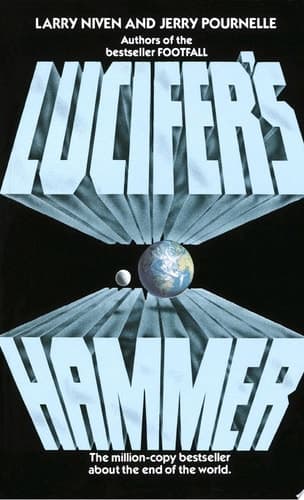
The gigantic comet had slammed into Earth, forging earthquakes a thousand times too powerful to measure on the Richter scale, tidal waves thousands of feet high. Cities were turned into oceans; oceans turned into steam. It was the beginning of a new Ice Age and the end of civilization.
But for the terrified men and women chance had saved, it was also the dawn of a new struggle for survival—a struggle more dangerous and challenging than any they had ever known. . . .
“Take your earthquakes, waterlogged condominiums, swarms of bugs, colliding airplanes and flaming what-nots, wrap them up and they wouldn’t match one page of Lucifer’s Hammer for sweaty-palmed suspense.”—Chicago Daily News
Recommendations
Generating recommendations…
Our AI is preparing recommendations for Lucifer's Hammer A Novel. This usually takes under a minute.
About Larry Niven
L
Larry Niven
Born 1938
Laurence van Cott Niven — known as Larry Niven — is an American science fiction writer. His best-known work is Ringworld (1970), which received Hugo, Locus, Ditmar, and Nebula awards. The Science Fiction Writers of America named him the 2015 recipient of the Damon Knight Memorial Grand Master Award. His work is primarily hard science fiction, using big science concepts and theoretical physics. It also often includes elements of detective fiction and adventure stories. His fantasy includes the series The Magic Goes Away, rational fantasy dealing with magic as a non-renewable resource. Niven was born in Los Angeles. He briefly attended the California Institute of Technology and graduated with a Bachelor of Arts in mathematics (with a minor in psychology) from Washburn University, Topeka, Kansas, in 1962. He did a year of graduate work in mathematics at the University of California at Los Angeles. On September 6, 1969, he married Marilyn Joyce "Fuzzy Pink" Wisowaty, a science fiction and Regency literature fan. He is an agnostic. Source: Wikipedia
View author page