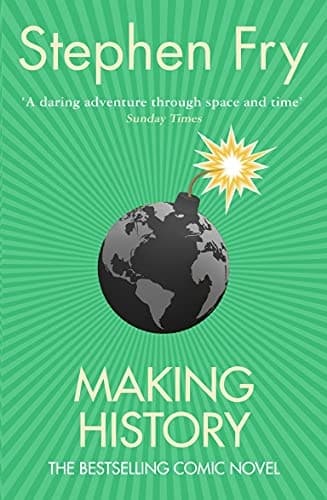
Synopsis
Those of us who have already discovered Stephen Fry know him as the brilliant British comedian behind TV series such as Jeeves & Wooster and Blackadder, and the author of two enormously funny novels, The Liar and The Hippopotamus. But his new film (in which he plays Oscar Wilde) and his new novel (this one) represent a somewhat alarming departure from his previous work: They're more serious. Though humor is still an essential ingredient of both, Fry's fans are finally getting to witness the emotional depth that this brilliant polymath usually keeps hidden.
In Making History, Fry has bitten off a rather meaty chunk by tackling an at first deceptively simple premise: What if Hitler had never been born? An unquestionable improvement, one would reason--and so an earnest history grad student and an aging German physicist idealistically undertake to bring this about by preventing Adolf's conception. And with their success is launched a brave new world that is in some ways better than ours--but in most ways even worse. Fry's experiment in history makes for his most ambitious novel yet, and his most affecting. His first book to be set mostly in America, it is a thriller with a funny streak, a futuristic fantasy based on one of mankind's darkest realities. It is, in every sense, a story of our times.
Recommendations
The Yiddish Policemen's Union
by Michael Chabon
Like Fry, Chabon takes a 'what if' historical premise—a temporary Jewish settlement in Alaska that became permanent—and uses it to explore how alternate realities can be simultaneously better and catastrophically worse. Both authors blend intellectual rigor with genuine emotional stakes, wrapping serious philosophical questions in plots that move like thrillers, and both have a gift for making you laugh at moments that should break your heart.
View book
Kurt Vonnegut, Jr.'s Slaughterhouse-five
by Tonnvane Wiswell
Published in 1969, this is your deeper dive into how fiction can grapple with historical atrocity without becoming didactic. Vonnegut shares Fry's ability to find dark humor in humanity's worst moments, and like Making History, it uses science fiction elements (time travel, alien abduction) as a framework for asking unanswerable questions about free will and the weight of history. The emotional gut-punch lands harder because Vonnegut never abandons his sardonic voice.
View book
Quicksilver Volume One of the Baroque Cycle
by Neal Stephenson
This is the surprise pick—a sprawling historical novel set in the 17th century that reads like Fry decided to write a 900-page book about the actual birth of the scientific method. Stephenson shares Fry's polymathic curiosity and ability to make complex ideas genuinely entertaining; both authors trust their readers' intelligence while maintaining a wry, observant narrative voice. If you loved the intellectual architecture of Making History, this will scratch that itch for ideas-as-plot.
View book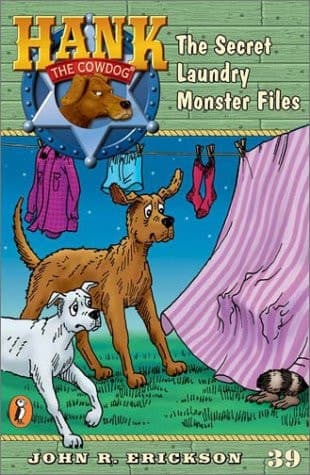
Hank The Cowdog: The Secret Laundry Moster Files 39
by John R. Erickson
Stross takes the premise that Lovecraftian cosmic horror is real and weaponizable, then asks what the British civil service would do about it—resulting in a novel that's part spy thriller, part mathematical philosophy, part comedy of bureaucratic absurdity. Like Fry, Stross writes characters who are genuinely intelligent and funny without being smug, and he shares that gift for making you care deeply about ideas while keeping the plot moving at breakneck speed.
View bookAbout Stephen Fry
S
Stephen Fry
Born 1957
Stephen John Fry (born 24 August 1957) is a British actor, writer, journalist, comedian, television presenter and film director. He first came to attention in the 1982 Cambridge Footlights Revue presentation, "The Cellar Tapes", which also included Hugh Laurie, Emma Thompson and Tony Slattery. With Hugh Laurie, as the comedy double act Fry and Laurie, he co-wrote and co-starred in A Bit of Fry and Laurie, and the duo also played the title roles in Jeeves and Wooster. As a solo actor, Fry played the lead in the film Wilde, was Melchett in the Blackadder television series and is the host of the quiz show, QI. He also presented a 2008 television series Stephen Fry in America, which saw him travelling across all 50 U.S. states in six episodes. Fry has become known to American audiences for his recurring guest role as Dr. Gordon Wyatt on the Fox crime series Bones. Since the publication of his first novel, *The Liar* (1993), Fry has written three additional novels, several non-fiction works and an autobiography. *Making History* (1997) is partly set in an alternative universe where Adolf Hitler's father is made infertile and his replacement proves a rather more effective Führer. The book won the Sidewise Award for Alternate History. *The Hippopotamus* (1994) centers around Edward (Ted/Tedward) Wallace and his stay at his old friend Lord Logan's country manor in Norfolk. *The Stars' Tennis Balls* (2000) is a modern retelling of The Count of Monte Cristo. Fry's book, *The Ode Less Travelled: Unlocking the Poet Within*, is a guide to writing poetry. In the United Kingdom, he is a well-known narrator of audiobooks, notably the Harry Potter series. He has recorded audio versions of works by Roald Dahl, Michael Bond, A. A. Milne, Anthony Buckeridge and Douglas Adams, as well as several of his own books. When writing a book review for Tatler, Fry wrote under an alias, Williver Hendry, editor of *A Most Peculiar Friendship: The Correspondence of Lord Alfred Douglas and Jack Dempsey*, a field close to Fry's heart as an Oscar Wilde enthusiast. Once a columnist in The Listener and The Daily Telegraph, he now writes a weekly technology column in the Saturday edition of The Guardian. His blog attracted more than 300,000 visitors in its first two weeks of existence. On 26 May 2009, Fry unveiled The Dongle of Donald Trefusis, an audiobook series following the character Donald Trefusis (a character from Fry's novel The Liar and from the BBC Radio 4 series Loose Ends), set over 12 episodes. After its release, it reached No. 1 on the UK Album Chart album chart list. ([Source][1]) [1]: http://en.wikipedia.org/wiki/Stephen_Fry
View author page