Synopsis
Not so long ago, the term “ideology” was in considerable disrepute. Its use had become associated with a claim to know a truth beyond ideology, a radically unfashionable position. What then explains the sudden revival of interest in grappling with the questions that “ideology” poses to social and cultural theory, as well as to political practice?
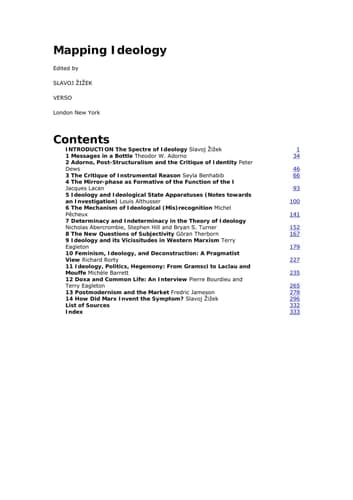
Mapping Ideology presents a comprehensive sampling of the most important contemporary writing on the subject. Slavoj iek’s introductory essay surveys the development of the concept from Marx to the present. Terry Eagleton, Peter Dews and Seyla Benhabib assess the decisive contributions of Lukács and the Frankfurt School. A different tradition is revealed in an essay by the French post-structuralist Michel Pêcheux, while the study of ideology is exemplified in classic texts by Theodor Adorno, Jacques Lacan and Louis Althusser. An intersection of Gramscian and Althusserian motifs appears in a now famous debate over “the dominant ideology thesis,” reprinted here. Pierre Bourdieu succinctly formulates his departure from this tradition in an interview with Eagleton. Further readings of the ideological are explored by Richard Rorty and Michèle Barrett. Finally Fredric Jameson supplies an authoritative statement of the nature and position of the ideological in late capitalist society. Mapping Ideology is an invaluable guide to what is now the most dynamic field of cultural theory.
Recommendations
Generating recommendations…
Our AI is preparing recommendations for Mapping Ideology (Mappings Series). This usually takes under a minute.
About Slavoj Žižek
S
Slavoj Žižek
Born 1949
Slavoj Žižek is Senior Researcher at the Institute for Social Sciences at the University of Ljubljana, Slovenia. He is a coeditor of Gaze and Voice as Love Objects and author of Tarrying with the Negative, both published by Duke University Press.
View author page