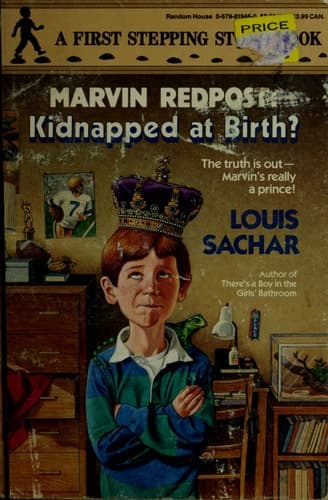
Marvin Redpost Kidnapped at birth?
Louis SacharPublished1992
Pages68
Formathardcover
PublisherRandom House
Synopsis
Illus. in black-and-white. Marvin Redpost has finally figured out why he
doesn't look like anyone in his family. He's not really Marvin Redpost--he's
Robert, the lost prince of Shampoon! "The story is wonderfully logical and
absurd, with a wit and attention to detail rare in an easy
reader."-- "Bulletin, Center for Children's Books." "Fast paced, easy to
read, and full of humor."-- "School Library Journal.
"
Recommendations
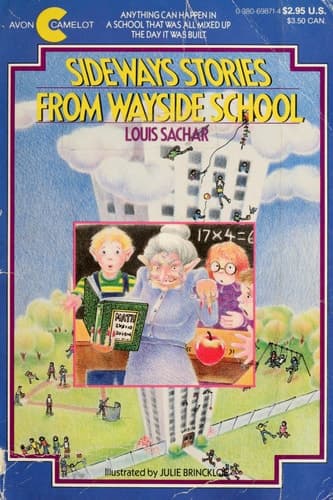
Sideways Stories from Wayside School
by Louis Sachar
Wait—I know you just finished Sachar, but hear me out. This collection has that same gleeful absurdist logic where ridiculous premises are treated with complete seriousness, and the humor comes from watching characters navigate genuinely weird situations without blinking. It's like Marvin's 'I'm actually a prince' revelation, but applied to an entire school where nothing follows normal rules.
View book
The Mysterious Benedict Society
by Trenton Lee Stewart
Stewart builds mystery the way Sachar builds absurdity—by layering clues and misdirection so cleverly that readers feel genuinely clever piecing things together. Like Marvin slowly realizing he might be royalty, these kids gradually uncover what's *really* happening around them, and the pacing keeps you turning pages at exactly the speed Sachar uses in his best work.
View book
Mary Wollstonecraft and the Feminist Imagination
by Barbara Taylor
This one's a bit of a curveball—it's historical fiction about young Ada Lovelace and Mary Shelley solving actual Victorian mysteries. But it shares Sachar's gift for making readers feel like they're in on a clever joke; the humor is drier and the stakes feel slightly more real, which gives you a chance to grow into a different flavor of smart-kid adventure while keeping that same page-turning momentum.
View book
Chasing Vermeer
by Blue Balliett
Balliett writes mysteries where the *form* of the book becomes part of the puzzle—there are hidden images in the illustrations, codes embedded in chapter titles. It's got that same 'wait, did I miss something?' quality that makes Marvin's realization so satisfying, except Balliett invites you to be an active detective rather than just following along with the protagonist.
View book
A Guide for Using From the Mixed-up Files of Mrs. Basil E. Frankweiler in the Classroom Based on the Novel Written by E.L. Konigsburg
by Mari Lu Robbins
Published in 1967, this is your bridge to a slightly earlier era of children's literature, but it shares Sachar's belief that kids are smart enough for genuine complexity and ambiguity. Two kids running away to live in the Metropolitan Museum discover that the mystery they're solving is actually about themselves—it has that same satisfying twist where the real revelation is personal, not just plot-based.
View bookAbout Louis Sachar
L
Louis Sachar
Born 1954
Biography coming soon.
View author page