Synopsis
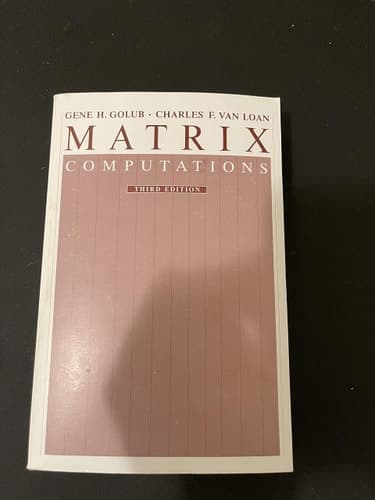
Revised and updated, the third edition of Golub and Van Loan's classic text in computer science provides essential information about the mathematical background and algorithmic skills required for the production of numerical software. This new edition includes thoroughly revised chapters on matrix multiplication problems and parallel matrix computations, expanded treatment of CS decomposition, an updated overview of floating point arithmetic, a more accurate rendition of the modified Gram-Schmidt process, and new material devoted to GMRES, QMR, and other methods designed to handle the sparse unsymmetric linear system problem.
Recommendations
Numerical Recipes in C++ The Art of Scientific Computing
by William H. Press
Where Golub gives you the theoretical foundations and rigorous proofs, Press et al. take those same algorithms and show you how to actually implement them in practice—it's like having the architect's blueprints versus the contractor's field guide. You'll recognize the mathematical concepts but see them translated into pragmatic code with all the real-world gotchas included.
View book
A Mathematician's Apology
by G. H. Hardy
This 1940 essay is a surprising pivot from your technical deep-dive, but Hardy writes about *why* mathematicians do what they do with the same precision Golub applies to algorithms—it's a meditation on beauty in mathematics that will make you reconsider what you're actually seeking when you work through a particularly elegant proof or efficient decomposition.
View book
The Art of Computer Programming
by Donald Ervin Knuth
Knuth approaches algorithmic thinking with the same obsessive rigor as Golub, but he's interested in the *analysis* of algorithms—how to measure their efficiency and understand their behavior at scale. If you found yourself wondering about computational complexity while reading Matrix Computations, this is where that curiosity leads.
View book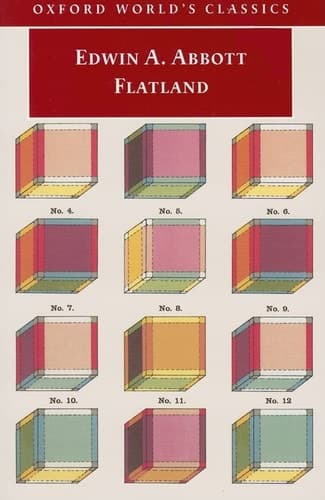
Flatland : A Romance of Many Dimensions A Romance of Many Dimensions
by Edwin A. Abbott
Here's your wildcard: a Victorian novella about geometry and dimensional thinking that's actually a satirical social commentary. Abbott explores how beings in different dimensions perceive reality through spatial relationships—it's a playful, almost literary way of thinking about the transformations and decompositions you've been studying, where matrices become a language for describing how different dimensional spaces relate to each other.
View book
Introduction To Algorithms
by Thomas H Cormen
While Golub focuses on the specific domain of matrix problems, Cormen et al. provide the broader algorithmic context—you'll see how the techniques you've mastered fit into the larger landscape of computational problem-solving, with careful attention to complexity analysis and correctness proofs that match the mathematical rigor you've come to expect.
View bookAbout Gene H. Golub
G
Gene H. Golub
Born 1932
Biography coming soon.
View author page