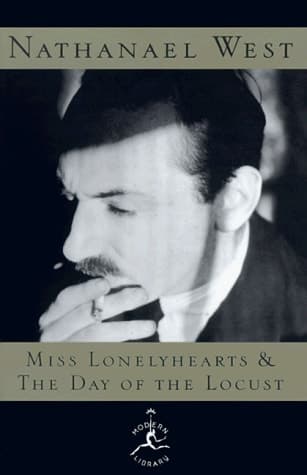
Miss Lonelyhearts and The Day of the Locust (Modern Library)
Nathanael WestPublished1998
Pages289
Formathardcover
PublisherModern Library
Synopsis
"Somehow or other I seem to have slipped in between all the 'schools,' " observed Nathanael West the year before his untimely death in 1940. "My books meet no needs except my own, their circulation is practically private and I'm lucky to be published." Yet today, West is widely recognized as a prophetic writer whose dark and comic vision of
a society obsessed with mass-
produced fantasies foretold much
of what was to come in American life.
Miss Lonelyhearts (1933), which West envisioned as "a novel in the form of a comic strip," tells of an advice-to-the-lovelorn columnist who becomes tragically embroiled in the desperate lives of his readers. The Day of the Locust (1939) is West's great dystopian Hollywood novel based on his experiences at the seedy fringes of the movie industry.
"The work of Nathanael West, savagely, comically, tragically original, has come into its own," said novelist and screenwriter Budd Schulberg. "A new public [has] discovered in the writings of West a brilliant reflection of its own sense of chaos and helplessness in a world running more to madness than to reason."
Recommendations
Generating recommendations…
Our AI is preparing recommendations for Miss Lonelyhearts and The Day of the Locust (Modern Library). This usually takes under a minute.
About Nathanael West
N
Nathanael West
1903–1940
Nathan Wallenstein Weinstein was born in 1903 in New York City. He attended Brown University and from 1924 to 1931 he lived in Paris, where he wrote *The Dream Life of Balso Snell*. On his return to New York, he managed a residential hotel and was associate editor, with [William Carlos Williams](https://openlibrary.org/authors/OL219856A/William_Carlos_Williams), of the magazine *Contact*. *Miss Lonelyhearts* appeared in 1933, *A Cool Million* in 1934 and *The Day of the Locust* in 1939. He worked on film scripts in Hollywood for the last five years of his life. He and his wife were tragically killed in a car accident in 1940. *--Penguin Books* Photo *--Wikicommons*
View author page