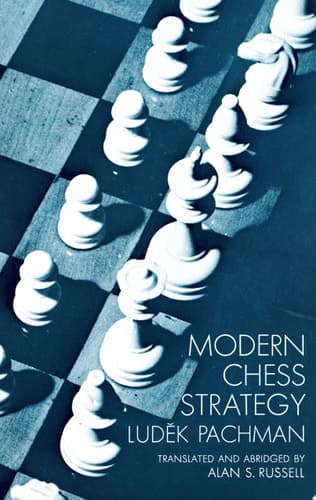
Synopsis
Every chess player hopes to set off brilliant combinations and win games in a blaze of glory. Such combinations do not come into being by themselves, however; they appear only as the result of proper chess strategy. It is therefore surprising that so few books deal with this highly important subject, and understandable that Pachman's modern classic has been so enthusiastically received by chessplayers at all levels.
Ludĕk Pachman, a Czech grandmaster, has long had an international reputation as a chess theorist, but until now his work has not been available in English. This present volume, which condenses his great Modern Schachstrategie, presents his ideas and theories in a form that the English-speaking world can assimilate easily. Beginning with basic concepts and the rules of the minor and major pieces, it covers the use of the Queen, the active King, exchanges, various kinds of Pawns, the center and its use, superiority on the wings, minority attack, strategical points and weak squares, methods of attack and defense, and similar topics. Pachman elaborates the various kinds of strategy that can be employed, and shows how each leads to tactical opportunities. It has been said that his section on the Rook alone make his book indispensable to the serious chess player, since the Rook is so important in both middle and endgames.
Pachman presents his method in the form of a thorough, systematic, analytical text, which draws upon scores of great games for exemplification. Both classical and very recent masters are included, although stress is on the moderns: Capablanca, Alekhine, Dr. Lasker, Rubinstein, Nimzovich, Botvinnik, Reshevsky, Bronstein, Smyslov, and Spasski.
Recommendations
The Ideas Behind the Chess Openings
by Reuben Fine
Kotov approaches chess philosophy from a different angle than Pachman—where Pachman builds strategy systematically from piece mechanics, Kotov explores the psychological and conceptual foundations of how masters *think* during play. You'll find the same rigor and classical game examples, but filtered through a Soviet grandmaster's perspective on calculation and intuition, giving you complementary frameworks for understanding the same strategic principles.
View book
The Healing Secrets of Food A Practical Guide for Nourishing Body, Mind, and Soul
by Deborah Kesten
Nunn, a contemporary English grandmaster, takes Pachman's foundational strategy and asks: how do you actually *apply* this in real games when you're tired, short on time, and facing unexpected positions? His book bridges the gap between theoretical understanding and tournament reality—less about perfect analysis and more about practical decision-making, which is where most players struggle after mastering Pachman's concepts.
View book
Capablanca's Hundred Best Games of Chess Masterpieces by the Mozart of the Chessboard
by Harry Golombek
Published in 1954, this is a delightful historical approach that predates Pachman's modern synthesis—Golombek traces how chess strategy *evolved* from the romantic era through the hypermodern revolution. If you're curious about *why* Pachman emphasizes certain principles (like the importance of the center), seeing how Capablanca and Nimzovich fought over these ideas in actual games provides fascinating context that enriches your reading of Modern Chess Strategy.
View book
Thinking Past Terror Islamism and Critical Theory on the Left
by Susan Buck-Morss
Here's the curveball: Kahneman's exploration of human decision-making under uncertainty directly illuminates what Pachman is teaching you about chess judgment. When Pachman discusses how to evaluate positions and choose between candidate moves, he's describing exactly the kind of intuitive pattern-recognition that Kahneman analyzes—you'll suddenly understand the *cognitive science* behind why experienced players 'just know' certain positions are winning, and how expertise rewires our thinking.
View book
Solitary Wicca For Life Complete Guide to Mastering the Craft on Your Own
by Arin Murphy-Hiscock
Smith writes for the ambitious amateur who's absorbed books like Pachman's and now wonders how to bridge the gap to genuine mastery. Rather than more theory, he focuses on *training methodology*—how to study positions, analyze your own games, and build the intuition that transforms abstract strategic knowledge into playing strength. It's the practical companion to Pachman's theoretical foundation.
View bookAbout Luděk Pachman
Biography coming soon.
View author page