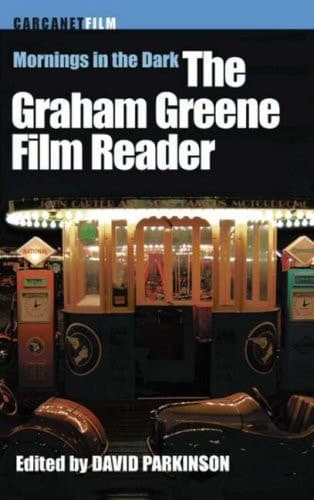
Mornings in the Dark The Graham Greene Film Reader
Graham GreenePublished2007
Pages738
Formatpaperback
PublisherCarcanet
Synopsis
Few novelists have taken films as seriously, or been as closely involved in so many aspects of the film business, as Graham Greene. His experience included producing, performing, script-writing and adaptation. And twenty years before he wrote the scripts to such celebrated films as Brighton Rock, The Fallen Idol and The Third Man, he had been one of the finest film critics of the 1930s, his intimate knowledge of the industry matched by his trenchant and perceptive responses to film as art, entertainment and social phenomenon.
Mornings in the Dark gathers some of Greene's best film criticism with a mass of related material: his film articles, interviews, lectures and radio talks, stories for film, letters and film proposals. With appendices on Greene's own films and unfulfilled film projects, and David Parkinson's introduction, this is an essential collection for readers and film enthusiasts alike.
Recommendations
The End of Celluloid: Film Futures in the Digital Age
by Matt Hanson
Thomson shares Greene's conviction that film criticism demands the same intellectual rigor as literary analysis, and his essays have that same penetrating quality—he'll make you see how a single camera angle reveals character in ways dialogue never could. If you appreciated Greene's ability to move fluidly between entertainment and art without condescension, Thomson's voice will feel like a natural continuation of that conversation.
View book
Die Wiederkehr der Zeichen: Eine psychoanalytische Studie zu Knut Hamsuns «Hunger» (Texte und Untersuchungen zur Germanistik und Skandinavistik) (German Edition)
by Thomas Fechner-Smarsly
This 1890 novel reads almost like a screenplay for the interior life—fragmented, obsessive, with a protagonist whose perceptions shift like unreliable narration in a psychological thriller. Greene understood that modernist technique could serve entertainment, and Hamsun does exactly that here: the formal experimentation never gets in the way of genuine human desperation, which is precisely the balance Greene sought in both his criticism and his own fiction.
View book
The Moviegoer
by Walker Percy
Percy's protagonist is a man who experiences life primarily through the lens of cinema—literally and philosophically—and the novel itself is structured with the pacing and emotional beats of a film. You'll find the same tension Greene explored: how does one live authentically in a world mediated by images and narratives? Percy asks it with Southern Gothic melancholy rather than Greene's Catholic anxiety, but the fundamental question is identical.
View bookGodard A Portrait of the Artist at Seventy
Godard A Portrait of the Artist at Seventy
by Colin MacCabe
This is a departure into biography-as-film-theory, but MacCabe writes about Godard's creative process with the same kind of forensic attention Greene brought to dissecting how films actually *work*. If you're curious about how a filmmaker's mind operates—the decisions, the accidents, the philosophy embedded in technique—this gives you that insider access Greene always provided, but focused on a director rather than a critic.
View book
The Savage Detectives A Novel
by Roberto Bolaño
Bolaño structures this sprawling novel like a film montage—multiple perspectives, non-linear time, characters who appear and disappear—and at its heart is a meditation on how we construct meaning from fragments and stories. Greene would have recognized Bolaño's conviction that form itself is content; the way this book refuses conventional narrative mirrors how experimental cinema refuses conventional viewing, and both demand an active, engaged reader.
View bookAbout Graham Greene
G
Graham Greene
Born 1926
Biography coming soon.
View author page