Synopsis
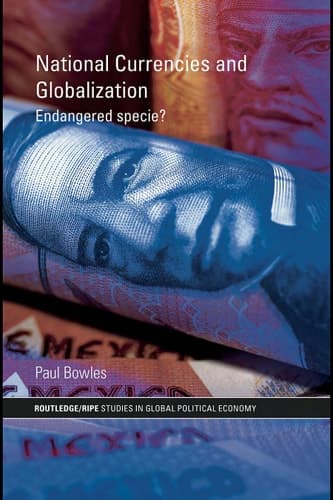
Globalization and money – two concepts inextricably linked. In many ways the speed with which financial resources traverse the globe, the opportunities which this provides for the efficient allocation of resources, the possibilities which this creates for financial crises and traders who act as agents removed from the concerns of national citizens have come to symbolize the phenomenon, hopes and fears of 'globalization'.
However, inextricably linked they may be, but well understood they are not. In the case of national currencies, a wide variety of predictions and analyses can be found. For some, national currencies represent barriers to a seamless global economy. Others argue that national currencies will disappear due to the power of international financial markets which will force national governments to adopt more credible currencies and abandon their own. In contrast, others see imperialism or regionalism as the main challenges.
Paul Bowles provides an innovative and systematic analysis of the implications of theories of globalization for national currencies. He critically examines whether, as a result, the world is heading for fewer currencies. He argues that the main 'force of globalization' which is endangering national currencies is that of globalization as 'neoliberal globalism'. However there is no single neoliberal position on money and so the 'contingent' nature of neoliberalism explains why this particular force of globalization operates more strongly in some countries than others. This is demonstrated in case studies of four systemically significant currencies, namely, those of Australia, Canada, Mexico and Norway.
National Currencies and Globalization will be of interest to researchers and students of International Political Economy, Politics, Economics and Finance.
Recommendations
Generating recommendations…
Our AI is preparing recommendations for National Currencies and Globalization Endangered Specie?. This usually takes under a minute.
About Paul Bowles
P
Paul Bowles
1910–1999
Paul Frederic Bowles (December 30, 1910 – November 18, 1999) was an American expatriate composer, author, and translator. He became associated with Tangier, where he settled in 1947 and lived for 52 years to the end of his life. Following a cultured middle-class upbringing in New York City, during which he displayed a talent for music and writing, Bowles pursued his education at the University of Virginia before making several trips to Paris in the 1930s. He studied music with Aaron Copland, and in New York wrote music for theatrical productions, as well as other compositions. He achieved critical and popular success with his first novel The Sheltering Sky (1949), set in what was known as French North Africa, which he had visited in 1931. In 1947 Bowles settled in Tangier, at that time in the Tangier International Zone, and his wife Jane Bowles followed in 1948. Except for winters spent in Sri Lanka (then known as Ceylon) during the early 1950s, Tangier was Bowles' home for the remainder of his life. He came to symbolize American immigrants in the city. Paul Bowles died in 1999 at the age of 88. His ashes are buried near family graves in Lakemont Cemetery, in upstate New York.
View author page