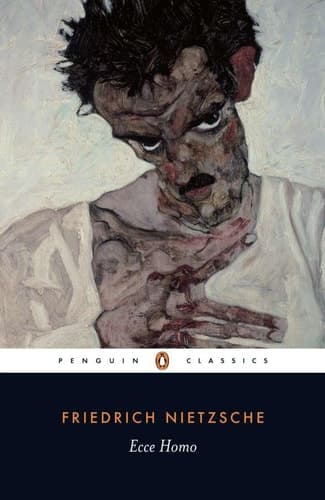
The Anti-Christ
Friedrich Wilhelm NietzschePublished1992
Pages144
Formatpaperback
PublisherPenguin Publishing Group
Synopsis
"Here is Friedrich Nietzsche's great masterpiece The Anti-Christ, wherein Nietzsche attacks Christianity as a blight on humanity. This classic is essential reading for anyone wishing to understand Nietzsche and his place within the history of philosophy ..."--Description from
Recommendations

Beyond Good and Evil
by Friedrich Wilhelm Nietzsche
Wait—I know what you're thinking. But hear me out: if you found *The Anti-Christ* exhilarating, this earlier work is where Nietzsche develops the philosophical architecture that makes his critique of morality so devastating. It's less polemical and more architectonic, which means you'll see *how* he builds his case rather than just the explosive conclusion.
View book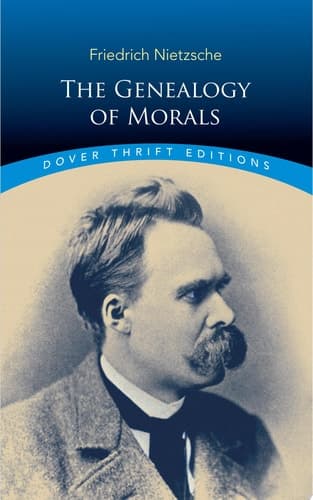
The Genealogy of Morals
by Friedrich Wilhelm Nietzsche
Foucault takes Nietzsche's genealogical method and applies it to how power actually *operates* in society—not through grand pronouncements but through the mundane machinery of institutions. Where Nietzsche diagnoses the sickness, Foucault shows you the anatomy of how it spreads, making his work feel like a natural continuation of your reading rather than a repetition.
View book
The Apocalyptic Vision of Mikhail Bulgakov's the Master and Margarita (Studies in Slavic Language & Literature)
by Edward E. Ericson
This is your surprise pick—a novel, not philosophy. But Bulgakov wrote it under Stalin while meditating on exactly what Nietzsche attacked: how religious and moral systems become tools of control. The Devil literally walks through Soviet Moscow, and the book's structure mirrors Nietzsche's fragmented, aphoristic style while telling a story that's darkly comic about the bankruptcy of official morality.
View book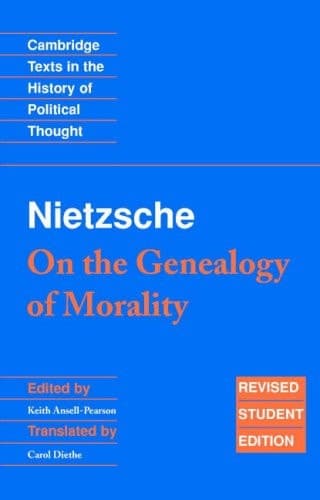
Nietzsche: 'On the Genealogy of Morality' and Other Writings Student Edition
by Friedrich Nietzsche
Deleuze reads Nietzsche not as a systematic thinker but as someone who *creates* new concepts—and then he does the same thing himself. If you're hungry to see Nietzsche's ideas weaponized in new directions (toward desire, difference, and becoming), Deleuze is the thinker who understood that Nietzsche wasn't trying to build a system but to destroy the very possibility of one.
View book
THE REBEL CLOTH ED
by Albert. translated From The French by Anthony Bower Camus
Camus engages directly with Nietzsche's legacy—particularly the question of whether rejecting all moral frameworks leads to liberation or nihilism. Written in 1951, it's from a different era than Nietzsche's work, and Camus uses concrete historical examples (revolution, terrorism, art) to test whether Nietzsche's vision actually works in the real world, not just in philosophy.
View bookAbout Friedrich Wilhelm Nietzsche
F
Friedrich Wilhelm Nietzsche
1917–1979
Giorgio Colli (1917 – 6 January 1979) was an Italian philosopher, philologist and historian. A native of Turin, taught ancient philosophy at Pisa's university for thirty years; he edited and translated Aristotle's *Organon and Kant's Critique of Pure Reason* for Einaudi, a major publishing house in Italy. Subsequently, he produced the first complete edition of Nietzsche's work (including all the posthumous fragments chronologically ordered) together with his friend Mazzino Montinari. His work culminated in *La Sapienza greca*, an edition and translation of the "Presocratics" (a term he rejected). Interrupted by his death in January 1979, it was supposed to be in eleven volumes. **Source**: [Giorgio Colli](https://en.wikipedia.org/wiki/Giorgio_Colli) on Wikipedia.
View author page