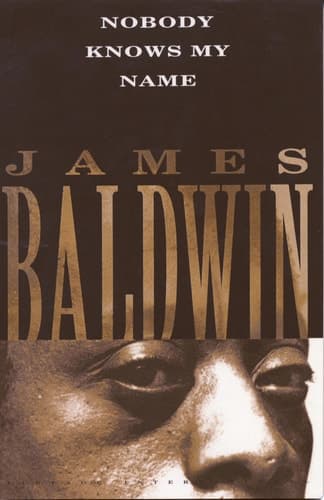
James Baldwin : Collected Essays : Notes of a Native Son / Nobody Knows My Name / The Fire Next Time / No Name in the Street / The Devil Finds Work / Other Essays (Library of America)
James BaldwinPublished1992
Pages256
Formatpaperback
PublisherKnopf Doubleday Publishing Group
Synopsis
Toni Morrison's definitive edition of James Baldwin's incomparable nonfiction.
Contains all the major essays collections in their entirety, plus 36 uncollected essays.
James Baldwin was a uniquely prophetic voice in American letters. His brilliant and provocative essays made him the literary voice of the Civil Rights Era, and they continue to speak with powerful urgency to us today, whether in the swirling debate over the Black Lives Matter movement or in the words of Raoul Peck's documentary "I Am Not Your Negro." Edited by Nobel laureate Toni Morrison, the Library of America's Collected Essays is the most comprehensive gathering of Baldwin's nonfiction ever published.
With burning passion and jabbing, epigrammatic wit, Baldwin fearlessly articulated issues of race and democracy and American identity in such famous essays as "The Harlem Ghetto," "Everybody's Protest Novel," "Many Thousands Gone," and "Stranger in the Village." Here are the complete texts of his early landmark collections, Notes of a Native Son (1955) and Nobody Knows My Name (1961), which established him as an essential intellectual voice of his time, fusing in unique fashion the personal, the literary, and the political.
The classic The Fire Next Time (1963), perhaps the most influential of his writings, is his most penetrating analysis of America's racial divide and an impassioned call to "end the racial nightmare...and change the history of the world." The later volumes No Name in the Street (1972) and The Devil Finds Work (1976) chart his continuing response to the social and political turbulence of his era and include his remarkable works of film criticism. A further 36 essays—nine of them previously uncollected—include some of Baldwin's earliest published writings, as well as revealing later insights into the language of Shakespeare, the poetry of Langston Hughes, and the music of Earl Hines.
LIBRARY OF AMERICA is an independent nonprofit cultural organization founded in 1979 to preserve our nation’s literary heritage by publishing, and keeping permanently in print, America’s best and most significant writing. The Library of America series includes more than 300 volumes to date, authoritative editions that average 1,000 pages in length, feature cloth covers, sewn bindings, and ribbon markers, and are printed on premium acid-free paper that will last for centuries.
Recommendations

Let Me be a Woman Notes to My Daughter on the Meaning of Womanhood
by Elisabeth Elliot
Lorde shares Baldwin's gift for fusing the deeply personal with the urgently political, but she brings a different lens—examining identity through the intersections of race, gender, sexuality, and class. Where Baldwin's essays often move from the particular moment outward to America's soul, Lorde works inward from theory to the body itself, making her essays feel like conversations happening in real time rather than pronouncements from on high.
View book
The Souls of Black Folk and Clotel By W.E.B. Du Bois
by DuBois Blight Gooding Bro
Published in 1903, this collection predates Baldwin by decades but reads as a conversation partner across time—Du Bois's concept of 'double consciousness' haunts every page of Baldwin's work. What makes this pairing special is watching how Baldwin both honors and argues with Du Bois's framework; you'll find yourself rereading both simultaneously, seeing how one writer's questions become another's answers.
View book
Year of the Unicorn (Witch World, No. 4)
by Andre Norton
This might seem like a left turn, but stay with me: Benally writes about Navajo history and contemporary Indigenous life with the same fearless specificity Baldwin brought to Black American experience. Her essays move between personal memoir, cultural criticism, and historical reckoning in ways that echo Baldwin's refusal to separate the literary from the political—just applied to a different community's struggle for visibility and sovereignty.
View book
A Mercy
by Toni Morrison
Since Morrison edited Baldwin's collected essays, you're already in conversation with her editorial sensibility, but her fiction deserves your attention too. Morrison does what Baldwin's essays do—excavate the interior lives obscured by America's official narratives—but through the novel form, letting her characters speak in their own voices across centuries. The prose has that same burning clarity Baldwin achieved, but working through story rather than argument.
View book
The Water of Life A Tale of the Grateful Dead, a Folk Story
by Alan Trist
Here's your genuine surprise: this is narrative nonfiction about an 18th-century naval disaster, but Mametsch writes with Baldwin's attention to how power operates through competing narratives and whose version of truth gets believed. Like Baldwin examining how America tells itself stories about race, Mametsch shows how the same historical event becomes radically different depending on who's narrating—it's a meditation on authority, testimony, and the stories we use to justify ourselves.
View bookAbout James Baldwin
J
James Baldwin
1924–1987
James Arthur Baldwin was an American novelist, writer, playwright, poet, essayist and civil rights activist. Most of Baldwin's work deals with racial and sexual issues in the mid-20th century in the United States. His novels are notable for the personal way in which they explore questions of identity as well as the way in which they mine complex social and psychological pressures related to being black and homosexual well before the social, cultural or political equality of these groups was improved. Source and more information: https://en.wikipedia.org/wiki/James_Baldwin
View author page