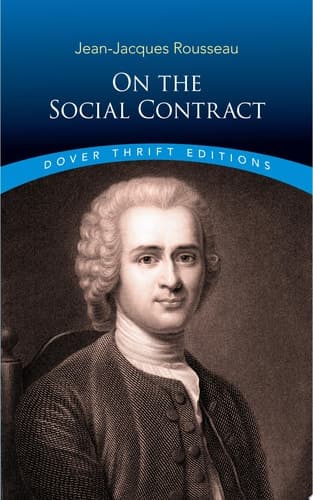
On the Social Contract
Jean-Jacques RousseauPublished2003
Pages97
Formatpaperback
PublisherCourier Corporation
Synopsis
"Man was born free, but everywhere he is in chains." Thus begins Rousseau's influential 1762 work, in which he argues that all government is fundamentally flawed and that modern society is based on a system of inequality. The philosopher posits that a good government can justify its need for individual compromises and that promoting social settings in which people transcend their immediate appetites and desires leads to the development of self-governing, self-disciplined beings. A milestone of political science, these essays are essential reading for students of history, philosophy, and other social sciences. G. D. H. Cole translation.
Recommendations
Generating recommendations…
Our AI is preparing recommendations for On the Social Contract. This usually takes under a minute.
About Jean-Jacques Rousseau
J
Jean-Jacques Rousseau
1712–1778
Jean-Jacques Rousseau was a major Genevois philosopher, writer, and composer of 18th-century Romanticism. His political philosophy influenced the French Revolution and the development of modern political, sociological and educational thought. His novel, *Emile: or, On Education*, which he considered his most important work, is a seminal treatise on the education of the whole person for citizenship. His sentimental novel, Julie, ou la nouvelle Héloïse, was of great importance to the development of pre-Romanticism and romanticism in fiction. Rousseau's autobiographical writings: his *Confessions*, which initiated the modern autobiography, and his *Reveries of a Solitary Walker* were among the pre-eminent examples of the late 18th-century movement known as the "Age of Sensibility", featuring an increasing focus on subjectivity and introspection that has characterized the modern age. Rousseau also made important contributions to music as a theorist. During the period of the French Revolution, Rousseau was the most popular of the philosophers among members of the Jacobin Club. He was interred as a national hero in the Panthéon in Paris, in 1794, 16 years after his death.<sup>[1][1]</sup> [1]: http://en.wikipedia.org/wiki/Jean-Jacques_Rousseau
View author page