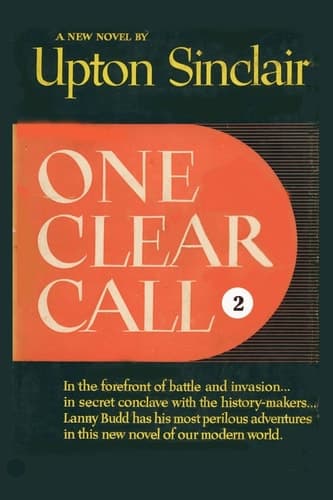
One Clear Call II
Upton SinclairPublished2001
Pages292
Formatpaperback
PublisherSimon Publications, Incorporated
Synopsis
Historisk roman om Europa i krigsårene 1943-44 med amerikaneren Lanny Budd
Recommendations
The Spy Who Loved Me
by Ian Fleming
Fleming's espionage thriller shares Sinclair's fascination with how ordinary people navigate extraordinary wartime circumstances, though Fleming trades Sinclair's sprawling historical canvas for intimate, high-stakes tension. Both authors use their protagonists' access to powerful figures to explore the moral ambiguities of intelligence work during global conflict.
View book
The remains of the day de Kazuo Ishiguro
by Gallix/François
Here's your surprise pick: where Sinclair gives you Lanny Budd moving through wartime Europe meeting world leaders, Ishiguro gives you a butler in post-war England quietly reckoning with how he enabled fascism through his own complicity and silence. Both explore how individuals are shaped by—and shape—the historical forces around them, but Ishiguro does it through restraint rather than Sinclair's expansive narrative.
View book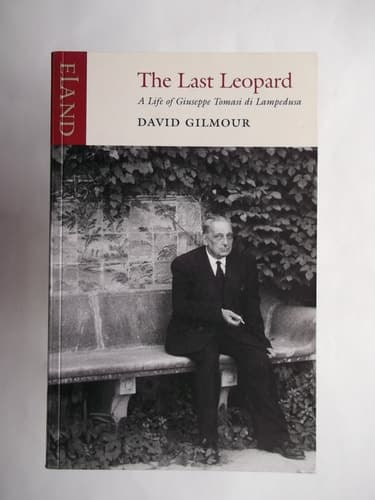
The Last Leopard: A Life of Giuseppe Tomasi di Lampedusa
by David Gilmour
Lampedusa captures that same bittersweet quality of watching history remake the world around you—in this case, Italian unification rather than WWII—with a protagonist who must decide whether to resist or adapt. Like Sinclair, Lampedusa uses a single family's experience to reflect larger historical upheaval, but with a European sensibility that feels like a natural companion to your recent read.
View book
All the Light We Cannot See A Novel
by Anthony Doerr
Doerr parallels Sinclair's interest in how WWII scattered people across continents and forced them into collision, but he builds his narrative through intimate dual perspectives rather than Sinclair's panoramic approach. Both authors ask how individuals maintain their humanity when caught between massive historical forces, though Doerr focuses on the interior emotional landscape where Sinclair emphasizes the political machinery.
View book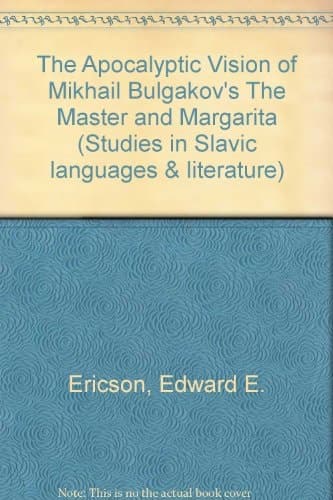
The Apocalyptic Vision of Mikhail Bulgakov's the Master and Margarita (Studies in Slavic Language & Literature)
by Edward E. Ericson
A wildly different approach to wartime Europe—Bulgakov weaves together Soviet Moscow, ancient Jerusalem, and the supernatural to explore how art and truth survive authoritarian systems. Where Sinclair grounds you in historical detail and political maneuvering, Bulgakov uses magical realism and satire to achieve something similar: showing how individuals resist and endure when history tries to erase them.
View bookAbout Upton Sinclair
U
Upton Sinclair
1878–1968
Upton Sinclair, Jr., was a Pulitzer Prize-winning American author who wrote over 90 books in many genres. He achieved popularity in the first half of the 20th century, acquiring particular fame for his 1906 muckraking novel The Jungle. It exposed conditions in the U.S. meat packing industry, causing a public uproar that contributed in part to the passage a few months later of the 1906 Pure Food and Drug Act and the Meat Inspection Act. --Wikipedia
View author page