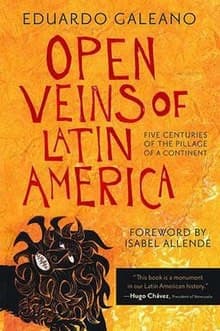
Open Veins of Latin America Five Centuries of the Pillage of a Continent
Eduardo GaleanoPublished1974
Pages339
Formatpaperback
PublisherMonthly Review Press
Synopsis
This classic set a new standard for historical scholarship of Latin America. It is also an outstanding political economy, a social and cultural narrative of the highest quality, and perhaps the finest description of primitive capital accumulation since Marx. Galeano has organized the various facets of Latin American history according to the patterns of five centuries of exploitation. Thus he is concerned with gold and silver, cacao and cotton, rubber and coffee, fruit, hides and wool, petroleum, iron, nickel, manganese, copper, aluminum ore, nitrates, and tin. These are the veins which he traces through the body of the continent, up to the Rio Grande and throughout the Caribbean, and all the way to their open ends where they empty into the coffers of wealth in the United States and Europe. Weaving fact and imagery into a rich tapestry, Galeano fuses scientific analysis with the passions of a plundered and suffering people.--From
Recommendations
Generating recommendations…
Our AI is preparing recommendations for Open Veins of Latin America Five Centuries of the Pillage of a Continent. This usually takes under a minute.
About Eduardo Galeano
E
Eduardo Galeano
1940–2015
Eduardo Galeano fue un periodista, escritor y novelista uruguayo. Sus obras más conocidas son Memoria del fuego (1986) y Las venas abiertas de América Latina (1971), que han sido traducidas a veinte idiomas y trascienden los géneros ortodoxos: combinan ficción, periodismo, análisis político e historia. El propio autor ha proclamado su obsesión como escritor diciendo: "Soy un escritor obsesionado con recordar, con recordar el pasado de América sobre todo y sobre todo el de América Latina, tierra íntima condenada a la amnesia". Ha recibido el Premio Internacional de Derechos Humanos de Global Exchange (2006) y el Premio Stig Dagerman (2010).
View author page