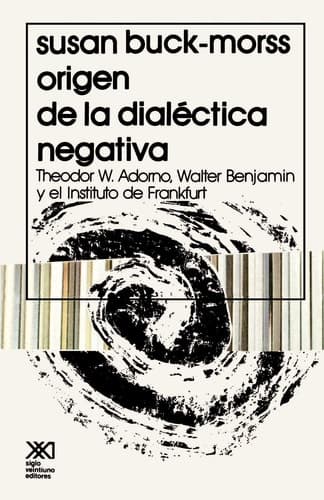
Origen de la dialectica negativa Theodor W. Adorno, Walter Benjamin y el Instituto de Frankfurt
Susan Buck-MorssPublished1981
Pages384
Formatpaperback
PublisherSiglo XXI
Synopsis
Este libro ya es un clásico de la teoría y el pensamiento intelectual, así como una referencia ineludible en los debates en torno a la escuela de Frankfurt. En tiempos de la Alemania de la Social Democracia y de levantamientos estudiantiles, Susan Buck-Morss se propuso rescatar la figura de Adorno y releer la tradición filosófica de la teoría crítica desde sus orígenes históricos. Así, analiza el pensamiento de Adorno, su formación y el desarrollo de lo que denominó "dialéctica negativa", pero también su deuda para con Walter Benjamin, con quien compartió una amistad intelectual y muchas afinidades pero también entabló un extenso debate teórico. ¿Cómo la temprana filosofía no marxista de Benjamin proporciona la clave para el método dialéctico, materialista, de Adorno?, esta es una de las preguntas que trata de responder Buck-Morss, quien ve en Adorno una figura central dentro de la revisión del marxismo del siglo xx. Un estudio lúcido y profundo que destaca la originalidad del proyecto filosófico de Adorno en comparación con otros exponentes del marxismo, así como su contribución en la formulación de una estética más allá del compromiso político. Una obra que, en medio de los debates actuales sobre la postautonomía de la literatura o el fin del arte, redobla su vigencia a la hora de pensar el estatus del arte y su valor.
Recommendations
The Good Society A Personal Account of Its Struggle with the World of Social Planning and a Dialectical Inquiry Into the Roots of Radical Practice
by John Friedmann
Jay's institutional history complements Buck-Morss's philosophical excavation by giving you the granular details of how the Frankfurt School actually functioned as a collective project. Where Buck-Morss traces the intellectual genealogy of negative dialectics, Jay shows you the seminars, the personalities, the funding crises—the lived reality behind the theory. You'll find yourself moving between these two books like they're in conversation with each other.
View book
The Savage Detectives A Novel
by Roberto Bolaño
This might seem like a left turn, but Bolaño's sprawling novel operates with the same restless intellectual energy you've just been reading—characters obsessed with aesthetic autonomy, the politics of artistic commitment, the impossibility of pure creation in a compromised world. The novel itself enacts a kind of negative dialectics through its form: it refuses easy resolution, fragments meaning, and makes you work through contradictions rather than resolve them. It's critical theory made into narrative experience.
View book
Minima Moralia Reflections from Damaged Life
by Theodor W. Adorno
Now that you understand the architecture of Adorno's thought through Buck-Morss's lens, reading his aphoristic essays directly will hit differently—you'll recognize the philosophical moves, the refusals, the way he turns everyday observations into theoretical provocations. It's more intimate than his major works, written in exile, and it shows you negative dialectics not as abstract method but as a way of living with irreconcilable contradictions.
View book
The German Ideology
by Karl Marx
Buck-Morss keeps circling back to how the Frankfurt School revised Marxism, and this early Marx-Engels manuscript is where many of those debates originate. Reading it now, you'll see exactly what Adorno and Benjamin were arguing *against* and *with*—the text becomes a kind of philosophical opponent that shaped their entire project. It's foundational in a way that will make everything you've just read snap into sharper focus.
View book
Walter Benjamin and the Arcades Project (Walter Benjamin Studies)
by Beatrice Hanssen
This is the Benjamin that haunts Buck-Morss's book—his unfinished magnum opus where he's trying to read capitalism itself as a text, finding revolutionary potential in forgotten urban spaces and commodity culture. It's fragmentary, sometimes maddening, but it's where you see Benjamin's method in action, the one that influenced Adorno so deeply. Coming to it after understanding their intellectual relationship, you'll read it as a kind of dialogue with Adorno across the pages.
View bookAbout Susan Buck-Morss
S
Susan Buck-Morss
Born 1942
Susan Buck-Morss (1942) is an American philosopher and intellectual historian. -Wikipedia
View author page