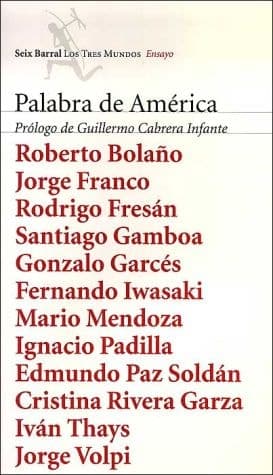
Palabra De America / Words from America (Spanish Edition)
Roberto BolañoPublished2004
Pages236
Formatpaperback
PublisherPlaneta Publishing
Synopsis
Sesiones de un congreso celebrado en Sevilla que reunió a autores jóvenes de América que escriben en castellano.
Recommendations
The Savage Detectives A Novel
by Roberto Bolaño
Wait—I know what you're thinking. But hear me out: *Palabra de América* is Bolaño reflecting on Latin American literature, while *The Savage Detectives* is him *doing* what he's theorizing about. This novel captures that same restless energy of young writers searching for meaning across a continent, but filtered through his most ambitious narrative architecture. It's the conversation made flesh.
View book
The Autumn of the Patriarch; Tr. from the Spanish by Gregory Rabassa
by Gabriel García Márquez
García Márquez was likely discussed in those Seville sessions, but this novel—not *One Hundred Years of Solitude*—shows you why he matters to the writers Bolaño was listening to. It's a masterclass in how to make language itself baroque and unreliable, mirroring a dictator's fractured consciousness. If you're interested in how Spanish-language writers push the boundaries of what prose can do, this is essential.
View book
Formen des Offenen: Thomas Manns "Zauberberg", die «Oxen of the Sun» - Episode in James Joyces "Ulysses" und Julio Cortázars "Rayuela" (Europäische ... Universitaires Européennes) (German Edition)
by Paul Forssbohm
Cortázar's masterpiece is the intellectual ancestor of everything discussed in that congress—a novel about writers, readers, and the act of creation itself that you can read in multiple orders. It's playful where Bolaño is austere, but both writers share an obsession with how literature actually *works* on a reader's mind, and both refuse to make it easy.
View bookThe Savage Detectives A Novel
by Roberto Bolaño
A contemporary Mexican writer who embodies exactly what Bolaño's congress was celebrating—young American authors writing in Spanish with formal innovation and political consciousness. Herrera's prose is tighter and more lyrical than Bolaño's, but he shares that commitment to making language do unexpected work while telling stories about power, migration, and survival.
View book
The Apocalyptic Vision of Mikhail Bulgakov's the Master and Margarita (Studies in Slavic Language & Literature)
by Edward E. Ericson
Here's your surprise: this 1960s Russian novel belongs on your shelf because it does something Bolaño clearly admired—it's a novel *about* literature and writers caught in a hostile political system, written with the same darkly comic energy and structural ambition. It's geographically distant from the Seville congress, but spiritually it's in the same conversation about what happens when writers refuse to be silenced.
View bookAbout Roberto Bolaño
Biography coming soon.
View author page