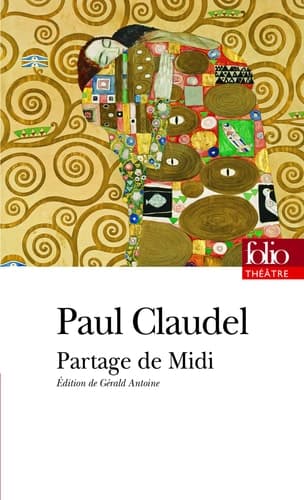
Partage de midi version de 1906 suivie de deux versions primitives inédites et de lettres, également inédites, à Ysé
Paul ClaudelPublished1994
Pages320
FormatPocket Book
PublisherGallimard
Synopsis
Cette édition constitue une événement. La pièce, qui date de 1906, est le chef-d'oeuvre de Claudel. Il y a enclos, dans un style brûlant et poétique, mariage de Shakespeare et de Rimbaud, le bonheur et le drame de sa vie. Ysé a abandonné son mari pour vivre avec Mesa ; elle quitte ce dernier pour un troisième homme qui ne la comble pas. Les deux protagonistes sont liés l'un à l'autre. L'homme, épris d'absolu et de Dieu, ne peut ni être satisfait par la femme ni s'en arracher. La femme aime cet homme qui la dépasse et la mène à son malheur, jusqu'à ce que triomphe "l'Esprit vainqueur dans la transfiguration de Midi". Au texte original s'ajoutent des éléments nouveaux : deux versions inédites, antérieures au texte de 1906, écrites par Claudel au milieu du drame de la rupture et de l'abandon, et des lettres également inconnues, écrites par le poète au modèle réel d'Ysé (et de la Prouhèze du Soulier de satin).
Recommendations
Phèdre A Play
by Jean Racine
Like Claudel, Racine distills human passion into language that feels almost unbearably concentrated—here, a woman consumed by forbidden desire for her stepson, unable to escape the logic of her own heart. Both playwrights use classical dramatic structures to trap their characters in spiritual and erotic paradoxes, though Racine's alexandrines are colder, more geometrically perfect than Claudel's baroque intensity.
View book
The Apocalyptic Vision of Mikhail Bulgakov's the Master and Margarita (Studies in Slavic Language & Literature)
by Edward E. Ericson
Bulgakov shares Claudel's conviction that the sacred and profane are inextricably tangled, and his novel has that same burning quality—part Shakespearean tragedy, part visionary mysticism. Where Claudel's drama unfolds in the Mediterranean heat of a single afternoon, Bulgakov spirals through Moscow's chaos, but both writers refuse to let their characters escape the gravitational pull of absolute love and absolute judgment.
View book
Estuche - Samuel Beckett: Molloy - Malone muere - El innombrable (Spanish Edition)
by Samuel Beckett
This might seem like a departure, but Beckett's obsessive, circular prose—a man unable to stop speaking about a woman he can barely remember—echoes Mesa's torment in *Partage de midi*. Where Claudel finds transcendence in the agony of separation, Beckett finds only the agony itself, stripped of consolation; yet both writers use language as a kind of incantation, repeating and circling until meaning dissolves into pure emotion.
View book
The Savage Detectives A Novel
by Roberto Bolaño
Bolaño's epic novel captures something Claudel understood: that passionate, self-destructive pursuit of the absolute (whether artistic, spiritual, or erotic) can consume entire lives and leave only fragments. His characters chase meaning across continents much as Mesa and Ysé are chased by their own natures, and Bolaño writes with that same feverish, baroque energy—though his tone is darker, more ironic about the possibility of redemption.
View book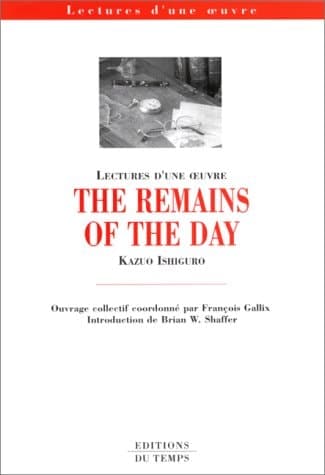
The remains of the day de Kazuo Ishiguro
by Gallix/François
A quieter choice, but Ishiguro's narrator is haunted by a love he never fully acknowledged, a life organized around duty and denial rather than passion—the inverse of Claudel's burning intensity. Yet both works are about the unbridgeable distance between two people, and how that distance becomes the deepest truth of a life. Ishiguro's restraint makes the emotional devastation all the more complete.
View bookAbout Paul Claudel
Biography coming soon.
View author page