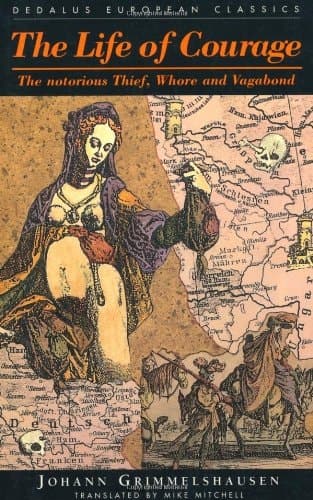
Synopsis
The Life of Courage (first published in 1670), one episode from whose life Brecht used as the basis for his Mother Courage, is the female counterpart to Simplicissimus. A young girl caught up in the turmoil of the Thirty Years War, she survives, even prospers, by the use of her native cunning and sexual attraction. Completely amoral, she flits from man to man, having a succession of husbands and lovers, and ends her life with a band of gypsies.
Courage supposedly tells her story to get her own back on Simplicissimus, who treats her rather dismissively in his memoirs. Her method is to reveal the truth about herself, including the fact that she was recovering from the pox at the time of their affair, so that he will be tarred with the same brush. The result is a lively account of lechery, knavery and trickery told with disarming frankness and a complete lack of remorse.
Recommendations
Generating recommendations…
Our AI is preparing recommendations for Phantom of the Opera. This usually takes under a minute.
About Gaston Leroux
G
Gaston Leroux
1868–1927
Gaston Louis Alfred Leroux was born in Paris and worked there as an author and journalist (<a href=http://en.wikipedia.org/wiki/Gaston_Leroux>Wikipedia</a>). His most famous work is <a href=http://en.wikipedia.org/wiki/The_Phantom_of_the_Opera>The Phantom of the Opera</a> as it has been made into films and a musical.
View author page