Synopsis
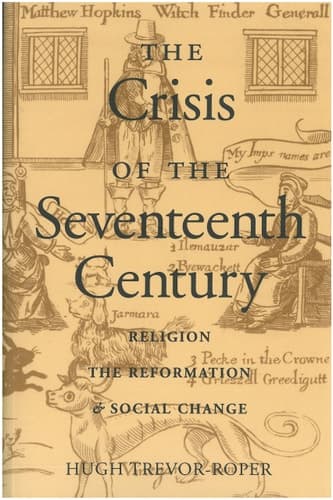
The Crisis of the Seventeenth Century collects nine essays by Trevor-Roper on the themes of religion, the Reformation, and social change.
In his longest essay, "The European Witch-craze of the Sixteenth and Seventeenth Centuries," Trevor-Roper points out that "in England the most active phase of witch-hunting coincided with times of Puritan pressure--the reign of Queen Elizabeth and the period of the civil wars--and some very fanciful theories have been built on this coincidence. But . . . the persecution of witches in England was trivial compared with the experience of the Continent and of Scotland. Therefore . . . [one must examine] the craze as a whole, throughout Europe, and [seek] to relate its rise, frequency, and decline to the general intellectual and social movements of the time."
Because Trevor-Roper believes that "the English Revolution of the seventeenth century cannot be isolated from a general crisis in Europe," he devotes the longest of his essays to the European Witch-craze. Events in England--and the intellectual currents from which they emerged and to which they gave impetus--cannot be understood apart from events and intellectual currents on the Continent.
Trevor-Roper acknowledges that the belief in witches, and the persecution of people believed to be witches, may be, to some at least, "a disgusting subject, below the dignity of history." However, he goes on, "[I]t is also a historical fact, of European significance, and its rise precisely in the years of the Renaissance and Reformation is a problem which must be faced by anyone who is tempted to overemphasize the 'modernity' of that period."
Hugh Trevor-Roper, Lord Dacre (1914-2003) was Regius Professor of Modern History at the University of Oxford.
Please note: This title is available as an ebook for purchase on Amazon, Barnes and Noble, and iTunes.
Recommendations
Generating recommendations…
Our AI is preparing recommendations for Political Writings. This usually takes under a minute.
About Samuel Johnson
S
Samuel Johnson
1709–1784
Samuel Johnson, was an English author who made lasting contributions to English literature as a poet, essayist, moralist, literary critic, biographer, editor and lexicographer. Johnson was a devout Anglican and committed Tory, and has been described as "arguably the most distinguished man of letters in English history".[1] He is also the subject of "the most famous single work of biographical art in the whole of literature": James Boswell's Life of Samuel Johnson.[2] ([Source][1].) [1]:http://en.wikipedia.org/wiki/Samuel_Johnson
View author page