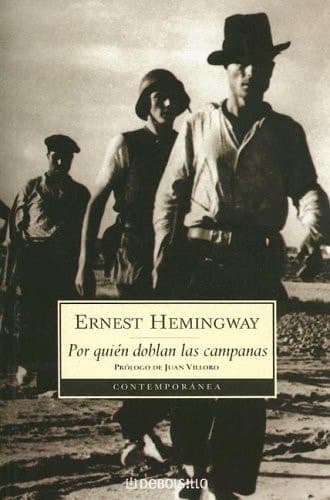
Por Quien Doblan Las Campanas
Ernest HemingwayPublished2005
Pages624
Formatpaperback
PublisherPenguin Random House Grupo Editorial
Synopsis
En los tupidos bosques de pinos de una región montañosa española, un grupo de milicianos se dispone a volar un puente esencial para la ofensiva republicana. La acción cortará las comunicaciones por carretera y evitará el contraataque de los sublevados. Robert Jordan, un joven voluntario de las Brigadas Internacionales, es el dinamitero experto que ha vendido a España para volar dicho puente. Allí, en las montañas, descubrirá los peligros y la intensa camaradería de la guerra. Y d escubrirá también a María, una joven rescatada por los milicianos de manos de las fuerzas sublevadas de Franco, de la cual se enamorará enseguida. Mientras atraviesan las montañas, Robert Jordan irá conociendo lo sucedido durante los primeros días de la sublevación hasta el momento en que se precipite la tragedia colectiva en que están inmersos. "Por quién doblan las campanas es la novela que le dio a Hemingway lo mejor y lo peor que puede recibir alguien con mentalidad de atleta: un triunfo insuperable."
Juan Villoro ENGLISH DESCRIPTION
Nobel Prize Winner 1954 In 1937 Ernest Hemingway traveled to Spain to cover the civil war there for the North American Newspaper Alliance. Three years later he completed the greatest novel to emerge from "the good fight," For Whom the Bell Tolls.
The story of Robert Jordan, a young American in the International Brigades attached to an antifascist guerilla unit in the mountains of Spain, it tells of loyalty and courage, love and defeat, and the tragic death of an ideal. In his portrayal of Jordan's love for the beautiful Maria and his superb account of El Sordo's last stand, in his brilliant travesty of La Pasionaria and his unwillingness to believe in blind faith, Hemingway surpasses his achievement in The Sun Also Rises and A Farewell to Arms to create a work at once rare and beautiful, strong and brutal, compassionate, moving, and wise. "If the function of a writer is to reveal reality," Maxwell Perkins wrote Hemingway after reading the manuscript, "no one ever so completely performed it." Greater in power, broader in scope, and more intensely emotional than any of the author's previous works, it stands as one of the best war novels of all time.
Recommendations
Generating recommendations…
Our AI is preparing recommendations for Por Quien Doblan Las Campanas. This usually takes under a minute.
About Ernest Hemingway
E
Ernest Hemingway
1899–1961
Ernest Miller Hemingway was an American writer and journalist. During his lifetime he wrote and had published seven novels; six collections of short stories; and two works of non-fiction. Since his death three novels, four collections of short stories, and three non-fiction autobiographical works have been published. Hemingway received the Nobel Prize in Literature in 1954. Hemingway was born and raised in Oak Park, Illinois. After high school he worked as a reporter but within months he left for the Italian front to be an ambulance driver in World War I. He was seriously injured and returned home within the year. He married his first wife Hadley Richardson in 1922 and moved to Paris, where he worked as a foreign correspondent. During this time Hemingway met, and was influenced by, writers and artists of the 1920s expatriate community known as the "Lost Generation". In 1924 Hemingway wrote his first novel, The Sun Also Rises. In the late 1920s, Hemingway divorced Hadley, married his second wife Pauline Pfeiffer, and moved to Key West, Florida. In 1937 Hemingway went to Spain as a war correspondent to cover the Spanish Civil War. After the war he divorced Pauline, married his third wife Martha Gellhorn, wrote For Whom the Bell Tolls, and moved to Cuba. Hemingway covered World War II in Europe and he was present at Operation Overlord. Later he was in Paris during the liberation of Paris. After the war, he divorced again, married his fourth wife Mary Welsh Hemingway, and wrote Across the River and Into the Trees. Two years later, The Old Man and the Sea was published in 1952. Nine years later, after moving from Cuba to Idaho, he committed suicide in the summer of 1961. Hemingway produced most of his work between the mid 1920s and the mid 1950s, though a number of unfinished works were published posthumously. Hemingway's distinctive writing style is characterized by economy and understatement, and had a significant influence on the development of twentieth-century fiction writing. His protagonists are typically stoical men who exhibit an ideal described as "grace under pressure." Many of his works are now considered classics of American literature. During his lifetime, Hemingway's popularity peaked after the publication of The Old Man and the Sea. [1] [1]: https://en.wikipedia.org/wiki/Ernest_Hemingway Source and more information: https://en.wikipedia.org/wiki/Ernest_Hemingway
View author page