Synopsis
An introduction to the techniques and algorithms of the newest field in robotics.Probabilistic robotics is a new and growing area in robotics, concerned with perception and control in the face of uncertainty. Building on the field of mathematical statistics, probabilistic robotics endows robots with a new level of robustness in real-world situations. This book introduces the reader to a wealth of techniques and algorithms in the field. All algorithms are based on a single overarching mathematical foundation. Each chapter provides example implementations in pseudo code, detailed mathematical derivations, discussions from a practitioner's perspective, and extensive lists of exercises and class projects. The book's Web site, has additional material. The book is relevant for anyone involved in robotic software development and scientific research. It will also be of interest to applied statisticians and engineers dealing with real-world sensor data.
Recommendations
Artificial Intelligence A Modern Approach
by Stuart Jonathan Russell
Where Thrun grounds robotics in probabilistic methods, Russell and Norvig give you the broader AI landscape that makes those methods necessary—you'll see how uncertainty handling fits into the larger puzzle of machine reasoning. This is the natural next step for someone who's comfortable with the mathematical rigor but wants to understand the philosophical and computational context.
View book
The Master Algorithm How the Quest for the Ultimate Learning Machine Will Remake Our World
by Pedro Domingos
Domingos writes like he's having a conversation with you about machine learning's competing tribes—Bayesians, evolutionaries, symbolists, connectionists, and analogizers—and he makes the case that probabilistic reasoning is the key to unifying them all. It's more narrative-driven than Thrun's textbook, so it'll feel like a palate cleanser while still deepening your understanding of why probabilistic approaches matter.
View book
Thinking Past Terror Islamism and Critical Theory on the Left
by Susan Buck-Morss
Here's the surprise pick: Kahneman explores how humans actually make decisions under uncertainty—which is precisely what you've been learning to make robots do mathematically. Reading about cognitive biases and heuristics after studying Bayesian inference will make you appreciate both how elegant probabilistic methods are *and* how messily human reasoning actually works.
View book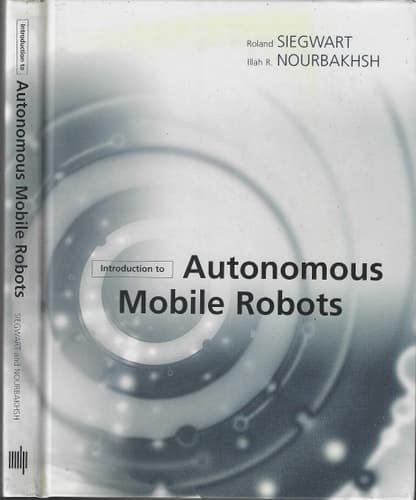
Introduction to Autonomous Mobile Robots
by Roland Siegwart
Siegwart and Nourbakhsh take the probabilistic foundations Thrun laid out and show you how they actually get implemented in real robots navigating real spaces—you'll see SLAM, path planning, and sensor fusion through the lens of a practitioner who's built these systems. It's more hands-on and systems-focused than Thrun's theoretical depth.
View book
Gödel, Escher, Bach: An Eternal Golden Braid
by Douglas Hofstadter
I know this seems like a left turn, but Hofstadter's meditation on self-reference, recursion, and emergent meaning in formal systems will make you think differently about what it means for a robot to have a model of itself and its world. Published in 1979, it's older than your source material, and it approaches the philosophy of artificial intelligence through music and art rather than equations—but the underlying questions about representation and meaning are deeply connected to what probabilistic robotics is trying to solve.
View bookAbout Sebastian Thrun
S
Sebastian Thrun
Born 1967
Biography coming soon.
View author page