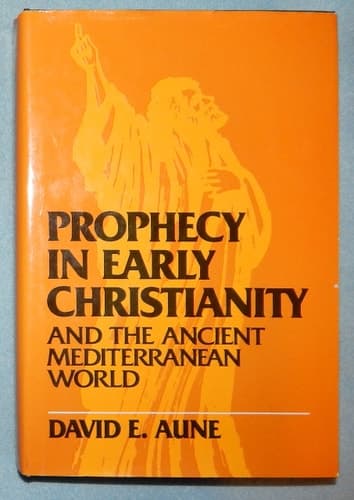
Prophecy in Early Christianity and the Ancient Mediterranean World
David Edward AunePublished1983
Pages534
Formathardcover
PublisherWilliam B. Eerdmans Publishing Company
Synopsis
The most detailed study of early Christian prophecy written. Places the phenomenon of early Christian prophecy within the larger Greco-Roman world.
Recommendations
The Botanist and the Vintner How Wine Was Saved for the World
by Christopher Campbell
Since you've just spent time with Aune's comprehensive framework for understanding early Christian prophecy, Heine's focused study of the Montanist movement gives you a case study in how prophecy actually functioned—and fractured—in practice. Where Aune provides the scaffolding, this book shows you the building in real time, with primary sources that reveal the tension between charismatic authority and institutional control.
View book
Gods, Oracles and Divination: Folkways in Chinua Achebe's Novels
by Kalu Ogbaa
This takes you sideways into the Greco-Roman context that Aune positioned as so crucial—but focuses on the pagan oracle systems that early Christians were actually competing with and responding to. You'll see how prophecy functioned as social technology across different religious systems, which deepens your understanding of what made Christian prophecy distinctive (or not).
View book
Beyond Charismatic Leadership The New York Catholic Worker Movement
by Michele Teresa Aronica
Meier approaches early Christian authority figures through a different lens—miracles rather than prophecy—but with the same meticulous historical methodology Aune uses. Reading these back-to-back, you'll notice how prophecy and miracle-working competed as forms of religious legitimacy, and how our sources sometimes blur them together.
View book
The Ecstatic Imagination Psychedelic Experiences and the Psychoanalysis of Self-Actualization
by Daniel Merkur
Rowland zooms in on the phenomenological side—what prophecy actually *felt like* to experience—rather than just its social function. If Aune gave you the map, this gives you the sensory experience of traveling it, drawing on mystical texts and visionary accounts that show prophecy as embodied religious experience.
View book
The Invention of Prophecy Continuity and Meaning in Hopi Indian Religion
by Armin W. Geertz
Here's your curveball: a book that treats prophecy as a *literary construction* rather than a historical phenomenon. Stuckenbruck examines how later Christian writers shaped and reshaped earlier prophetic traditions to serve their own theological agendas. It's a completely different mode of analysis—almost postmodern in its skepticism—but it'll make you reconsider how much of what Aune reconstructs is history versus historiography.
View bookAbout David Edward Aune
Biography coming soon.
View author page