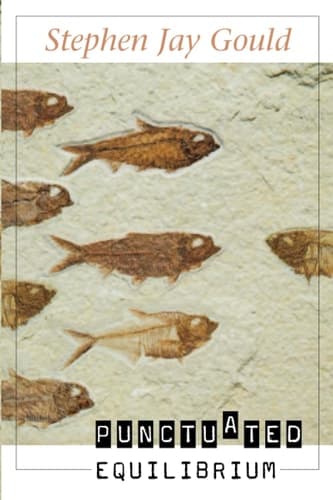
Punctuated Equilibrium
Stephen Jay GouldPublished2007
Pages406
Formatpaperback
PublisherHarvard University Press
Synopsis
In 1972 Stephen Jay Gould took the scientific world by storm with his paper on punctuated equilibrium, written with Niles Eldredge. Challenging a core assumption of Darwin's theory of evolution, it launched the career of one of the most influential evolutionary biologists of our time--perhaps the best known since Darwin.
Now, thirty-five years later, and five years after his untimely death, Punctuated Equilibrium (originally published as the central chapter of Gould's masterwork, The Structure of Evolutionary Theory) offers his only book-length testament on an idea he fiercely promoted, repeatedly refined, and tirelessly defended. Punctuated equilibrium holds that the great majority of species originate in geological moments (punctuations) and persist in stasis. The idea was hotly debated because it forced biologists to rethink entrenched ideas about evolutionary patterns and processes. But as Gould shows here in his typically exhaustive coverage, the idea has become the foundation of a new view of hierarchical selection and macroevolution.
What emerges strikingly from this book is that punctuated equilibrium represents a much broader paradigm about the nature of change--a worldview that may be judged as a distinctive and important movement within recent intellectual history. Indeed we may now be living within a punctuation, and our awareness of what this means may be the enduring legacy of one of America's best-loved scientists.
Recommendations
The Selfish Gene
by Richard Dawkins
Dawkins shares Gould's gift for taking a single organizing principle and using it to reframe how we understand life itself—but where Gould emphasizes stasis and sudden change, Dawkins focuses on replication and competition at the genetic level. Both books are intellectual revolutions disguised as explanations, and you'll find yourself constantly pausing to reconsider what you thought you knew about evolution.
View book
The Structure of Scientific Revolutions
by Thomas S. Kuhn
Kuhn's concept of paradigm shifts is the philosophical scaffolding that makes Gould's punctuated equilibrium so intellectually satisfying—and this 1962 classic will deepen your appreciation for what Gould was actually arguing about beyond just fossils and species. You'll recognize how Gould's work is itself an example of the very mechanism Kuhn describes.
View book
Tobias of the Amish A True Story of Tangled Strands in Faith, Family, and Community
by Unknown
Quammen does for molecular biology what Gould did for paleontology—he shows how a radical rethinking of life's architecture (horizontal gene transfer) upended everything we thought we knew about the tree of life. His narrative style is more journalistic than Gould's, but the intellectual drama is equally gripping, and you'll see how modern genetics has further complicated the evolutionary picture Gould was already complicating.
View book
Quilting and Braiding The Feminist Christologies of Sallie McFague and Elizabeth A. Johnson in Conversation
by Shannon Schrein
This might seem like a departure, but Kimmerer does something Gould would have appreciated: she challenges the Western scientific worldview itself by showing how indigenous knowledge systems have long understood ecological relationships and change in ways that Western science is only now catching up to. It's a gentle but profound punctuation in how we think about knowledge and time.
View book
The Apocalyptic Vision of Mikhail Bulgakov's the Master and Margarita (Studies in Slavic Language & Literature)
by Edward E. Ericson
Here's your wildcard: Bulgakov's 1967 novel operates on the principle of sudden, disorienting shifts in reality and perspective—characters move between Soviet Moscow and ancient Jerusalem, the narrative itself refuses linear progression, and nothing is quite what it seems. If you appreciated how Gould's punctuated equilibrium forces you to reconsider the very nature of change and continuity, this novel does something similar to narrative itself, creating a kind of literary punctuation that mirrors the intellectual one you've just been reading about.
View bookAbout Stephen Jay Gould
Biography coming soon.
View author page